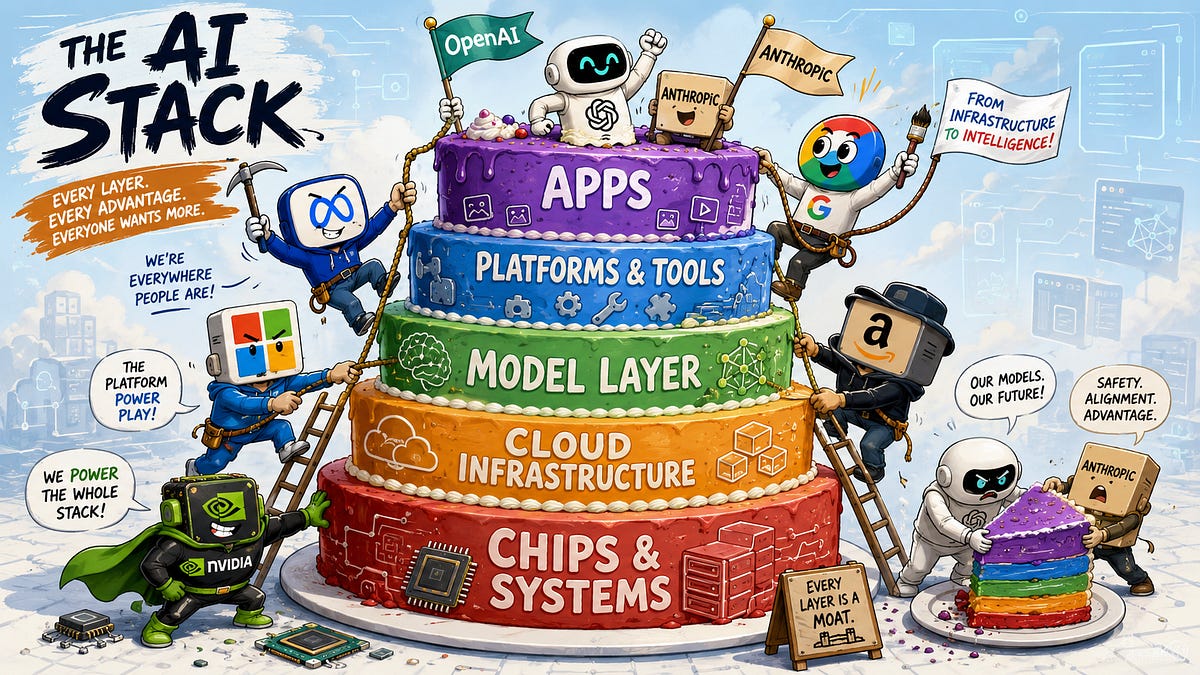
The AI stack is a battlefield. That’s the blunt truth behind Jensen Huang’s five-layer cake analogy. Energy, chips, infrastructure, models, applications. He paints a picture of unity, each layer supporting the next, a virtuous cycle where applications drive demand all the way down to the power grid. It’s a nice story. Especially if you’re selling the bottom layer.
But peel back the frosting, and the cake is less about harmony and more about a multi-layered war for profit. Every layer represents a potential margin pool. The real fight isn’t about owning the whole cake; it’s about owning the scarce part. The part no one else can easily replicate. And crucially, owning the seam right next to it.
This isn’t new, of course. Think of the early days of computing. IBM owned the mainframe. Then came the PC, with Microsoft owning the operating system. Intel dominated the chips. Each era has its dominant players controlling a critical bottleneck. AI is no different, just faster and more expensive.
The Scarcity Game: Where’s the Real Power?
Huang’s vision of synergy is a masterclass in marketing. For a chip vendor like NVIDIA, making sure the entire stack thrives is good business. But for a strategist looking at the same diagram, it’s a series of distinct profit centers, each vying to avoid becoming a commodity. The pressure is immense to vertically integrate, to capture more of that cake before a competitor commoditizes your slice.
Consider the layers. Energy is foundational, but also diffuse. Chips? That’s NVIDIA’s playground, incredibly capital-intensive and difficult to replicate at scale. Infrastructure – the cloud, data centers – is a battleground dominated by hyperscalers like AWS, Azure, and Google Cloud, who also have significant use over model and application developers. Models themselves are becoming increasingly democratized, though the truly cutting-edge ones still require immense resources. Applications are the most numerous but often the least defensible without control over the underlying stack.
What Huang misses, or perhaps chooses to de-emphasize, is that the AI race isn’t about building a beautiful, collaborative cake. It’s about carving out the richest slice and building moats around it. The companies that succeed will be those that control a scarce resource and the adjacent choke points.
The cake is not a structure of mutual reinforcement. It is a battlefield with a vertical axis.
This statement cuts to the quick. It’s a zero-sum game disguised as an ecosystem. The goal for each player is to own the layer of highest scarcity. For NVIDIA, it’s chips. For cloud providers, it’s the infrastructure and the integration of models. For AI model companies, it’s the frontier research and the ability to serve those models efficiently.
Why Does This Matter for Startups?
Startups face a daunting landscape. They often lack the capital to compete on the hardware or infrastructure layers. Their best bet is to find an underserved niche at the application layer, or to build truly novel models that offer a distinct advantage. But even then, they are beholden to the providers of chips and infrastructure. This dependency can be crippling, turning innovation into a negotiation with a few dominant players.
Think about the constant push for proprietary hardware or specialized AI chips. It’s an attempt to break free from reliance on NVIDIA or to create an even scarcer resource. But it’s an arms race, incredibly expensive and prone to falling behind.
The real winners will be those who can either command the scarce layer or build a strong enough lock-in at the application layer that they can dictate terms to the layers below. It’s a brutal, capital-intensive game. And Jensen Huang, standing at the base of his five-layer cake, knows exactly who’s profiting most from the ingredients.
This isn’t just about technology; it’s about economic power and strategic dominance. The AI stack is indeed a battlefield, and the war for control is just heating up. Who controls the scarce layer wins. Simple as that.
🧬 Related Insights
- Read more: Vendor Blind Spots: The Third-Party Risks Quietly Torpedoing Client Security
- Read more: Digital Wallets and AI Agents: Checkout’s Messy Makeover
Frequently Asked Questions
What does Jensen Huang mean by the five-layer AI cake?
Jensen Huang, CEO of NVIDIA, uses a five-layer cake analogy to describe the AI ecosystem: energy, chips, infrastructure, models, and applications. He presents it as a harmonious system where each layer supports the others, driving demand down the stack. His intention is to highlight the interconnectedness and the importance of hardware (chips) at the base.
Is the AI stack really a battlefield?
Yes, the article argues that while the cake analogy suggests harmony, the AI stack is fundamentally a series of competing margin pools. Companies are fighting to control the ‘scarce’ layers of the stack – those that are difficult to replicate and highly profitable – and the interfaces between them, rather than simply reinforcing each other.
How can startups compete in this AI stack battle?
Startups typically lack the capital for hardware or infrastructure layers. Their best strategies involve finding niche application areas, developing truly novel models that offer unique advantages, or building strong customer lock-in at the application level. However, they remain dependent on chip and infrastructure providers, making strategic partnerships and differentiation crucial.