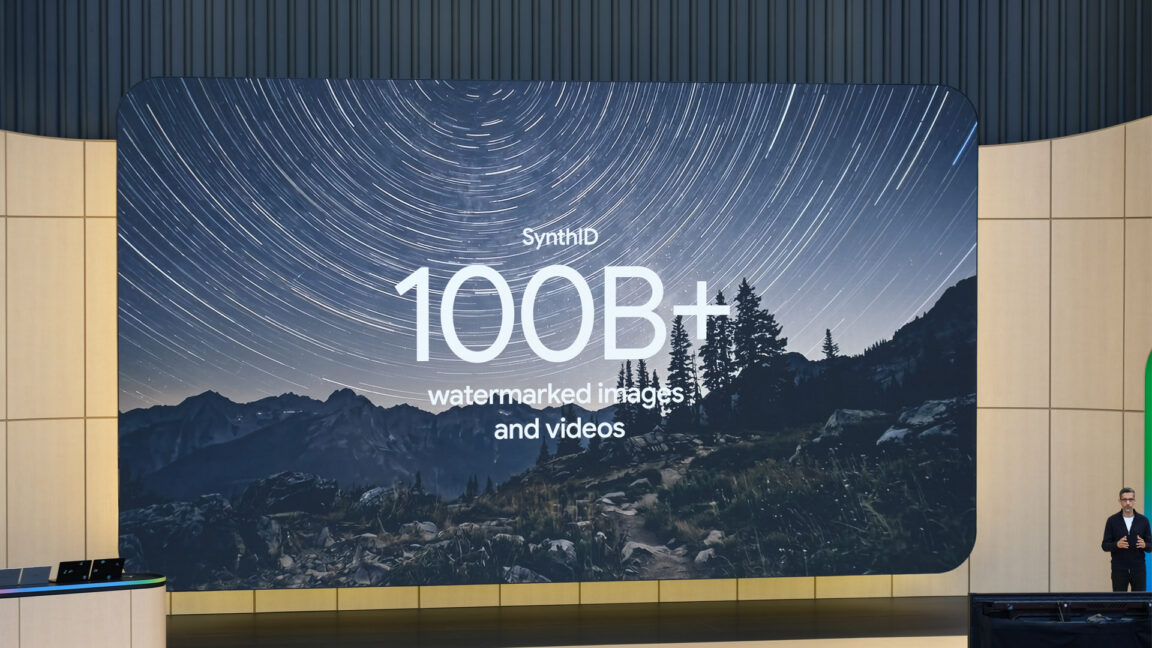
The digital Wild West is getting a sheriff, or at least, a watermark. Google’s SynthID, the tech giant’s answer to identifying AI-generated content, is no longer just a Google thing. We’ve gone from silly AI-generated images with six fingers to content so real it could fool your grandma. And now, big players like OpenAI and Nvidia are jumping on board with Google’s solution. Suddenly, identifying what’s fake in this AI-saturated world feels… slightly less impossible.
It started with Google, of course. They rolled out SynthID a few years back, a tool designed to embed a digital watermark directly into AI-generated images, videos, and audio. The claim? It’s nearly impossible to remove, even with aggressive editing. They say they’ve tagged trillions of digital assets – an astronomical number that’s only going to grow now that the gates are open.
And it’s not just SynthID. Google’s also pushing the C2PA standard, which essentially slaps a metadata tag on content, detailing its origin and creation process. Think of it as a digital pedigree for your photos and videos. They’ve been quietly baking this into their Pixel phones, and now it’s coming to videos recorded on their latest models, and even their Gemini chatbot is getting the ability to scan and explain a file’s provenance. Chrome and Search will follow suit.
But let’s be clear: SynthID is the star here. The C2PA stuff is good, sure, but metadata can be fiddled with. SynthID, on the other hand, is meant to be baked into the very fabric of the digital creation. “A technology like this will always be attacked,” admits Pushmeet Kohli, a scientist at Google DeepMind. “There was a lot of research that we did in making SynthID strong to different kinds of transformations.” strong. That’s the word they want you to remember. Like a digital cockroach, surviving compression, cropping, and rotation.
Who’s Actually Making Money Here?
This is where my ears perk up. For twenty years, I’ve watched Silicon Valley chase the next big thing, and the pitch is always the same: make the world better, safer, more efficient. But rarely do you hear the CEO talking about the shareholder dividends from increased societal trust. The real money, historically, has been in control. Control of the platforms, control of the data, and now, control of authenticity.
Google’s playing a long game. By making SynthID an industry standard, they’re not just selling a product; they’re setting the rules of the road. If OpenAI and Nvidia are adopting it, it means they’re either acknowledging Google’s lead or, more likely, they need a credible way to address the rising tide of deepfakes and misinformation to protect their own businesses. They’re all in the AI generation business, and if their creations start causing real-world chaos – think election interference, fake news that tanks stock markets, or just utter public distrust – that chaos eventually comes for them.
So, who benefits? Google, for one. They get to position themselves as the responsible guardian of the digital frontier, a position that’s incredibly valuable. They also get to collect valuable data on who’s using what AI, and how. For OpenAI and Nvidia, it’s a necessary evil. They get to continue pushing the boundaries of generative AI while showing the world – and regulators – that they’re taking the risks seriously. It’s damage control, plain and simple, wrapped in a shiny new tech solution.
Is This Just Another Band-Aid?
Look, I’m old enough to remember when every tech company promised to “disrupt” something. Now, it’s all about “ethical AI” and “trustworthy systems.” SynthID is a technical solution to a social problem. It’s a digital fingerprint. But fingerprints can be smudged, or worse, faked.
My concern is that this focus on technical watermarking distracts from the deeper issues: the speed of AI development outstripping our ethical frameworks, the motivations behind creating hyper-realistic synthetic media in the first place, and the sheer power wielded by the few companies that control these generative models. Will this watermark truly stop malicious actors? Or will it just become another layer of complexity that sophisticated bad actors learn to bypass, leaving the rest of us trying to decipher what’s real?
This feels like a race where the finish line keeps moving. Every technological advancement in detection is met with an even more advanced method of evasion. It’s an arms race, and the consumers are often the collateral damage. We’re being asked to trust the very companies that are building the most powerful generative AI tools to also police them effectively. History, as I’ve seen it unfold from the front lines of Silicon Valley, suggests that profit often trumps prudence.
What’s Next for AI Content Detection?
If SynthID is the current best answer, it’s a start. But don’t expect this to be the last word. We’ll likely see a proliferation of these watermarking technologies, each vying for industry adoption. We might also see a shift towards more strong provenance tracking, perhaps involving decentralized ledgers or blockchain, to create tamper-proof records of content creation. And then there’s the arms race between creators and detectors – a perpetual game of cat and mouse that will surely spawn a whole new industry of AI content detection services.
Google’s SynthID, now adopted by OpenAI and Nvidia, is a significant step. It’s an acknowledgement that the genie is out of the bottle and we need some way to keep track of it. But let’s not get too comfortable. The digital landscape is about to get a whole lot weirder, and this watermark is just one tool in a very complex fight for digital truth.
🧬 Related Insights
- Read more: Your LLM Prompts Are a Mess at Scale—Here’s How to Fix It Before Disaster Strikes
- Read more: DeepMind Exposes AI Agent Traps: Poisoned Pasta Pages That Hijack Bots
Frequently Asked Questions
What does Google’s SynthID do? SynthID embeds a digital watermark into AI-generated content like images, videos, and audio, making it identifiable even after edits. It’s designed to be difficult to remove.
Will SynthID stop deepfakes? SynthID aims to identify AI-generated content, which can help in detecting deepfakes. However, sophisticated actors may find ways to circumvent it, and it doesn’t inherently stop the creation of deceptive content.
Is SynthID free to use for other companies? Google is making SynthID available to other companies, suggesting a path for broader adoption and integration into their own AI development and content generation tools. Details on specific licensing or partnership models are not fully detailed but its adoption by major players indicates availability.