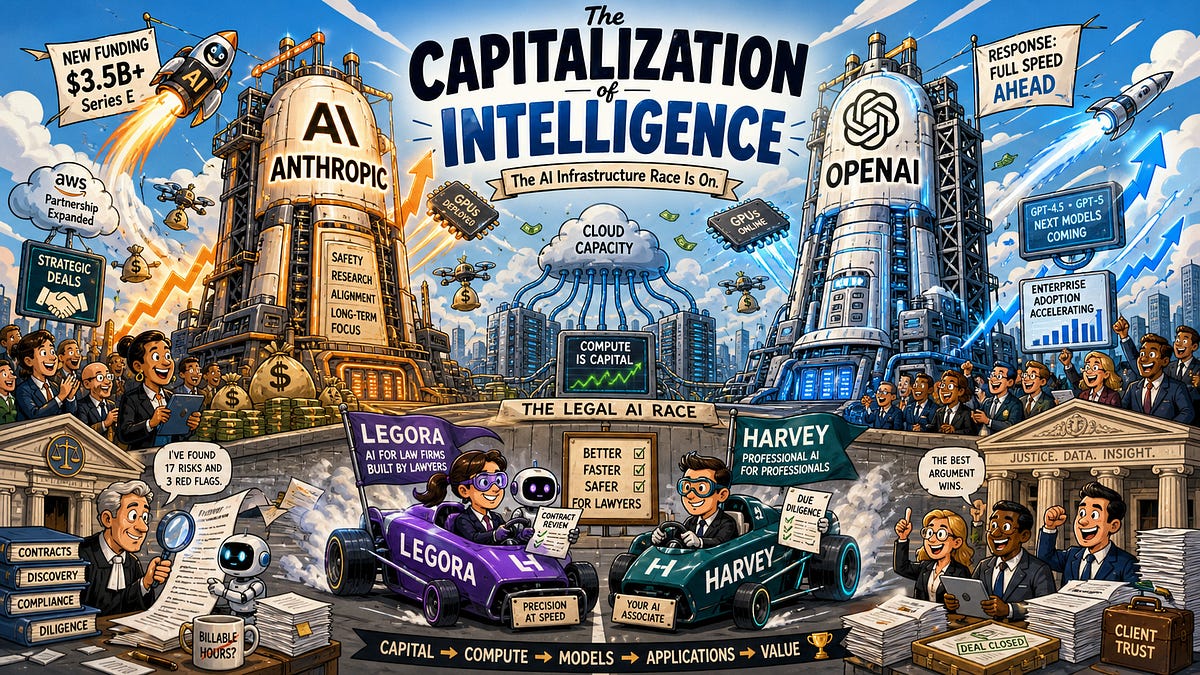
We all thought the AI revolution would be about smarter chatbots, fancier image generators, maybe even a few helpful agents that don’t get stuck in infinite loops. And sure, those things are still happening, humming along in the background like a pleasant hum. But this week? This week was a seismic shift. The narrative flipped, and suddenly, the AI world wasn’t just about code; it was about colossal sums of money, about positioning for a future that looks less like a startup garage and more like a national treasury.
Here’s the thing: the center of gravity this week wasn’t a new model release. It was Anthropic. Whispers turned into reports: the Claude maker is eyeing a new funding round that could skyrocket its valuation north of a staggering $900 billion. Yes, you read that right. That’s not just investor hype; it’s the market screaming that we’re entering a new paradigm. This isn’t just about who has the cleverest algorithm anymore; it’s about who can build the industrial juggernaut that powers the entire intelligence infrastructure.
Think about it. Google is reportedly throwing up to $40 billion Anthropic’s way. Amazon’s matching with up to $25 billion more, tied to a massive cloud partnership. And it’s not just cloud; they’re talking compute from Broadcom, CoreWeave, Amazon’s own custom chips, and even their own data center ambitions. This is intelligence morphing into infrastructure, and infrastructure, as history teaches us, demands a balance sheet that can rival nations.
The old race—who has the best model?—is quaint now. The new race is about the entire stack: the capital structure, the compute supply chain, the cloud distribution channels, the developer ecosystems, the enterprise trust layers, and that elusive agentic operating system. OpenAI, for its part, just snagged itself more flexibility by renegotiating its Microsoft deal, making itself a more attractive partner for Amazon and others. It’s a high-stakes chess match, played out in billions.
The Vertical Play: From Chatbots to Operating Systems
This pattern of deep capital infusion isn’t just for the hyperscalers. Look at Legora, the legal AI startup. They just extended their Series D by $50 million, bringing the total round to $600 million and hitting a $5.6 billion valuation. With established players like Atlassian and Nvidia’s NVentures jumping in, Legora isn’t just building a chatbot for lawyers. They’re building an agentic operating system for legal workflows—research, diligence, drafting, precedent analysis—the whole nine yards.
It’s a fascinating counterpoint to Harvey’s elite legal tech aura. Harvey has the top-tier law firm mindshare and an $11 billion valuation. Legora? It’s the European insurgent with explosive ARR growth and a clear vision for turning legal work into automated, intelligent workflows. This isn’t about lawyers using AI; it’s about AI doing the legal work, quietly, efficiently, and at scale.
Europe’s $1 Billion Bet on Radical AI
And then there’s Ineffable Intelligence, landing in London with a jaw-dropping $1.1 billion seed round at a $5.1 billion valuation. This is Europe’s biggest seed financing ever. What’s the pitch? Not another LLM. No, David Silver, the mastermind behind AlphaGo, is betting on reinforcement learning—systems that learn from experience, not just by crunching human data. In a week already packed with capital wars, Ineffable feels like the pure research-world equivalent: billion-dollar bets on the next frontier, not just the current one.
This week’s lesson is simple: AI is leaving the toy-box phase. Frontier labs are becoming trillion-dollar infrastructure companies. Vertical AI startups are becoming operating systems for professional work.
It’s a radical pivot. The intelligence explosion, once a philosophical debate, is now a capitalization explosion. We’re seeing frontier AI labs funded not as nascent startups but as civilizational experiments. The market is placing bets not just on today’s LLM winners, but on what intelligence looks like when it’s fully unleashed as fundamental infrastructure.
Is this the end of the small AI startup?
Not entirely. Niche applications and specialized tools will always find a home. However, building foundational AI models or large-scale agentic systems now requires capital on an unprecedented scale, making it incredibly difficult for smaller players to compete directly with these behemoths.
What does this mean for developers?
It means opportunities to build on top of these powerful new platforms. Developers will be key to creating the applications, agentic workflows, and specialized interfaces that will use these massive AI infrastructures. The demand for skilled AI engineers and prompt engineers will only continue to soar.
Will AI replace jobs?
This wave of investment suggests AI is being built to automate and augment complex professional tasks, not just simple ones. While certain roles might be transformed or reduced, new roles will emerge focused on managing, directing, and developing AI systems. The focus is shifting towards human-AI collaboration, with AI handling more of the heavy lifting.
