Recursion is the new scaling law.
For the longest time, AI progress followed a tired, predictable formula: bigger models, more data, more compute. It was industrial. Predictable. The Transformer era, the foundation model wave — all built on this. Loss curves were roadmaps. Compute budgets were strategy. The only question was, ‘how much bigger?’
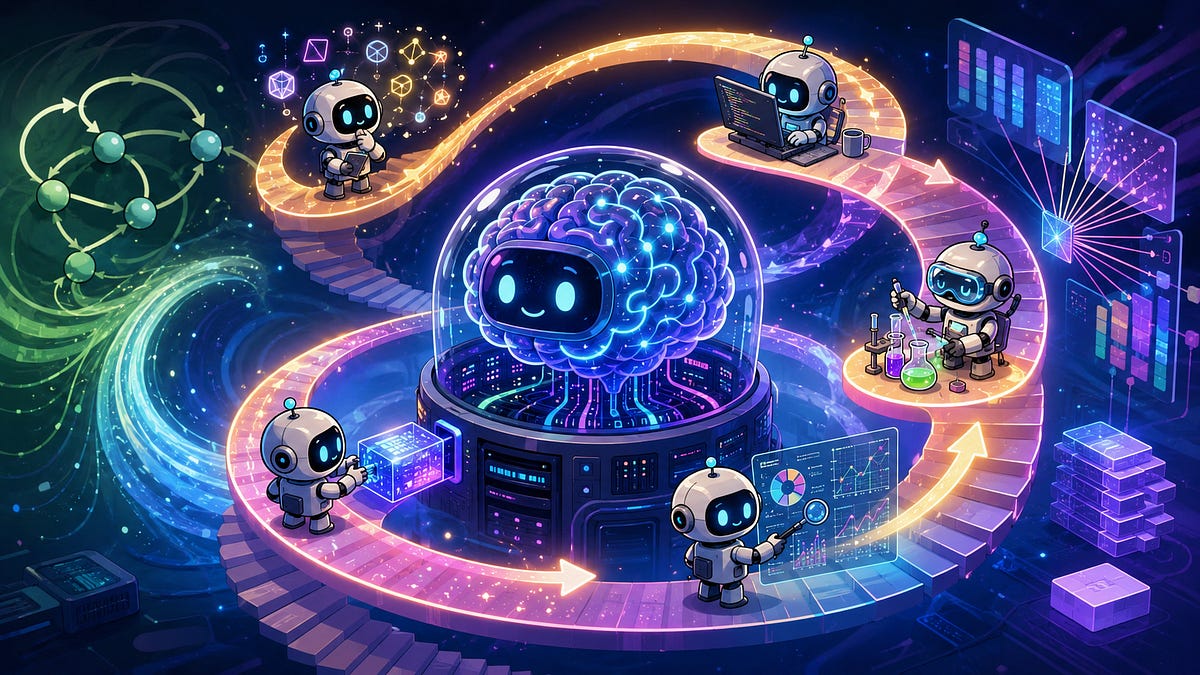
But that’s changing. The most exciting AI breakthroughs aren’t linear anymore. It’s not just about a bigger model spitting out a better answer on the first try. Now, it’s about models that can revisit, revise, search, simulate, critique, and actually improve. The crucial unit of computation? It’s shifting. From the simple ‘forward pass’ to the ‘loop’.
So, here’s the provocative thought: recursion might be the next scaling law.
This isn’t some fringe theory. Look at the advancements in agentic computing. These systems aren’t just executing a single command. They’re planning. They’re strategizing. They’re—get this—thinking. This recursive capability allows them to break down complex problems, try solutions, evaluate their failures, and try again. Think of it like a human architect sketching a design, then refining it, critiquing it, and iterating until it’s perfect. Not just one draft, but a process.
And this shift demands a rethink of how we measure AI progress. We’re moving beyond raw parameter counts and FLOPS. The real magic is in the process. How efficiently can a model loop? How good is its self-correction? How adept is it at exploring solution spaces? These are the metrics that will define the next generation of AI, not just how many transistors you can cram onto a chip.
Is this the end of big models? Not exactly. They’re still the foundation. But they’re becoming tools, not the end-all-be-all. Imagine a powerful language model not just writing an essay, but writing an essay, then critiquing it, then rewriting it based on its own critique, and doing this until it meets a predefined standard of excellence. That’s recursion in action.
Of course, this presents new challenges. Debugging recursive systems is harder. Understanding why a recursive AI made a specific decision—its chain of thought, its internal revisions—becomes a much more complex puzzle. We’re trading linear interpretability for emergent intelligence. A Faustian bargain, perhaps?
The important unit of computation is shifting from the forward pass to the loop.
This evolution is already yielding tangible results. Systems that can better plan multi-step tasks, AI agents that can reliably perform complex sequences of actions online, and even models that can synthesize new scientific hypotheses are all benefiting from this iterative, recursive approach. It’s moving AI from passive information processors to active problem solvers.
But let’s not get ahead of ourselves. This isn’t a universally adopted paradigm yet. Many in the field are still focused on the old playbook. And there’s a valid argument to be made that simply scaling up existing architectures might still unlock significant capabilities. However, the most interesting work—the kind that feels genuinely new—is leaning heavily into recursion.
And that’s the key point. The industry often chases the loudest hype. But sometimes, the quiet shift—the move from one computational paradigm to another—is what truly reshapes the landscape. This recursion trend feels like one of those shifts. It’s less about brute force and more about finesse. Less about size, more about smarts. It’s agentic computing’s secret sauce.
Why Does This Matter for Developers?
For developers building with AI, this means a shift in how they approach problems. Instead of just prompting a model and hoping for the best, they’ll need to design systems that enable recursion. This might involve building frameworks for self-correction, error handling, and iterative refinement. It’s about architecting for intelligence, not just for output. Expect tools that facilitate loop management, reflection, and planning to become increasingly important. It’s moving beyond simple API calls to building intelligent workflows.
Is Recursion Truly the Next Scaling Law?
It’s a bold claim. ‘Scaling law’ implies a predictable, quantifiable improvement with increased resources, much like model size or data. Recursion, by its nature, is more about algorithmic efficiency and emergent behavior. So, while it might be the next frontier for breakthroughs, framing it as a direct replacement for the established mathematical concept of scaling laws might be a slight overreach. However, it undeniably represents the most promising avenue for advancing AI capabilities beyond current limitations. It’s the new metric that matters, even if it doesn’t fit neatly into an old equation.
**
🧬 Related Insights
- Read more: PayPal, Convera, and Nium Are Betting Big on Stablecoins—But Regulators Aren’t Done Writing the Rules
- Read more: Clio’s Agents Take Over: How Legal Work Just Got Smarter and More Autonomous
Frequently Asked Questions**
What is agentic computing? Agentic computing refers to AI systems designed to act autonomously, making decisions and taking actions in an environment to achieve specific goals, often involving planning and iteration.
Will recursion make AI more creative? Recursion’s ability to explore, revise, and self-critique can lead to more nuanced and novel outputs, potentially enhancing creativity by allowing for more complex problem-solving and idea generation than a single pass.
How does recursion differ from traditional AI scaling? Traditional AI scaling focuses on increasing model size, data, and compute for better performance in a single pass. Recursion focuses on iterative processes, self-improvement, and loops for more complex problem-solving, shifting the focus from model size to algorithmic efficiency and problem-solving strategy.