The Frontier Lab Blueprint
Forget the hype; the real gatekeepers to frontier AI labs are wielding the tools of performance. This isn’t about clever prompts, it’s about deep, low-level mastery.
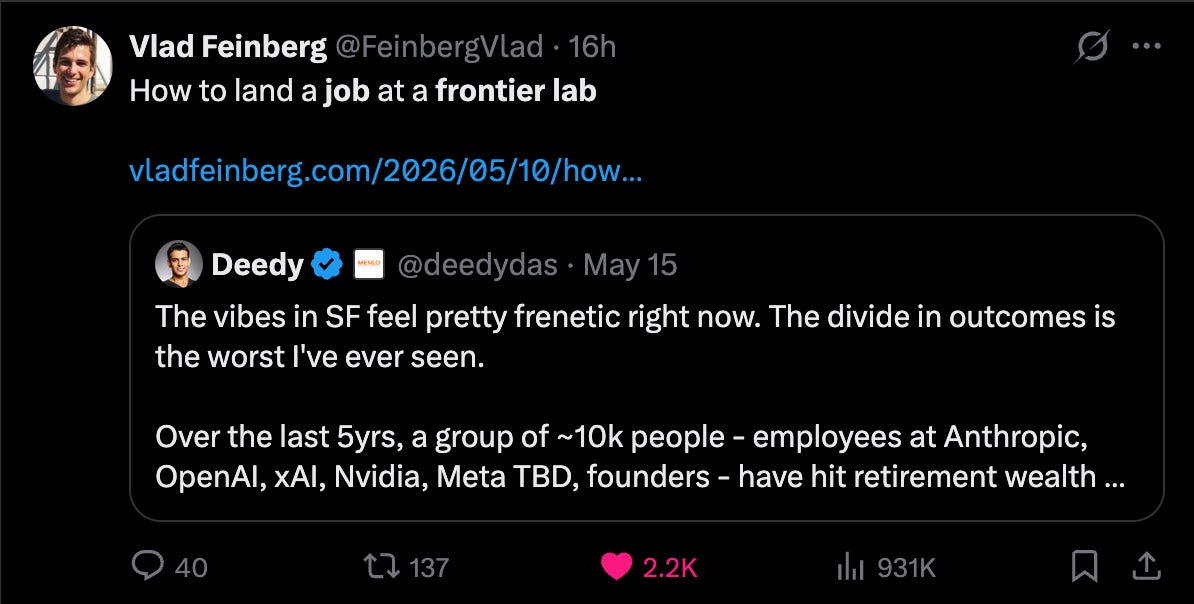
This week, amidst the pre-Google I/O quiet, a fascinating dispatch from Vlad Feinberg dropped, offering a starkly practical roadmap for anyone aiming to land a coveted spot at the bleeding edge of AI research. It’s not about who can craft the most poetic prompt. No, this is about digging into the silicon trenches, about understanding the very heartbeat of these colossal models.
He points us to DeepMind’s Scaling handbook, a tome that sounds academic but, at its core, is about raw efficiency. “The biggest bottleneck and innermost loop of all LLM work is performance work that makes abstract, logical changes to the LLM practical to run.” This is the message. It’s a call to arms for engineers who can coax every last nanosecond of performance out of hardware that’s already pushing the boundaries of what’s possible. Think of it like tuning a Formula 1 engine; it’s not enough to just drive fast; you need to understand every bolt, every fuel line, every nuance of its operation. This is the most direct path into these vaunted labs.
And here’s the kicker – it’s not just about brute-force optimization. Feinberg drops a surprising mention of Domain Specific Languages (DSLs) for kernel development, a topic with a surprisingly rich (and often overlooked) history in accelerating computational tasks. It’s a reminder that innovation often lies in finding the right specialized language to speak to the machine, not just shouting louder.
Kernel Tuning: The New Gatekeeper
This isn’t just theoretical. Feinberg lays out a gauntlet, a series of challenges that act as the true hiring test. These aren’t your typical take-home assignments. These are deep dives into the mechanics of pretraining, demanding not just understanding but creation from scratch. We’re talking about deriving Chinchilla laws and, crucially, seeing how they differ for dense versus MoE (Mixture-of-Experts) architectures. This is where the rubber meets the road, where theory confronts practical implementation.
But it doesn’t stop there. The real showstopper? Crafting a Pallas kernel that beats existing, highly optimized operations like jax.lax.ragged_dot for specific F > D scenarios. This requires fusing projections, identifying specific operating conditions where a measurable speedup occurs, and, most importantly, being able to articulate why that speedup happens. It’s the difference between knowing that something is faster and truly understanding how and why it achieves that speed. This is the kind of insight that separates the wheat from the chaff at places like Google’s TPU teams.
This is a fundamental platform shift we’re witnessing. AI is no longer just about clever algorithms; it’s becoming a deep engineering challenge, a battle for performance at the most granular level. It’s like the early days of the internet, where understanding TCP/IP was the secret sauce. Now, understanding kernel-level operations for LLMs is becoming that secret sauce.
The Agent Shift: Beyond Chatbots
Beyond the deep kernel work, there’s a palpable shift in the AI landscape, moving away from simple conversational agents towards more persistent, automated systems. This is evident in the maturing infrastructure for production agents. LangSmith Engine, for instance, is positioned as the missing CI/CD loop, automating failure detection and drafting fixes from production traces. Cognition’s Devin Auto-Triage acts as a 24/7 first responder for bugs, complete with long-term memory and proactive PR generation. The common thread? Less “chat with an agent,” more “persistent automation tied to traces, memory, and evals.”
This operational evolution extends to coding agents. Anthropic is refining best practices for deploying Claude Code across massive codebases, while OpenAI expands Codex workflows with features like Zoom plugins and mobile/desktop remote execution. The trajectory is clear: background execution, remote supervision, and agent fan-out are becoming the norm, not interactive snippets. As François Chollet aptly framed it, coding agents are “blind squirrels” requiring carefully placed, verifiable constraints. The practical consensus? Agent quality hinges more on verification surfaces, decomposition, and feedback loops than on prompt cleverness alone.
And then there are the model releases. Cursor’s Composer 2.5 stands out, promising better sustained work on long-running tasks. But the core message remains: the path to the frontier labs isn’t paved with buzzwords, but with a profound understanding of the underlying mechanics. It’s a future built on performance, efficiency, and a deep, almost architectural, grasp of how these systems truly operate.
“The biggest bottleneck and innermost loop of all LLM work is performance work that makes abstract, logical changes to the LLM practical to run.”
AI is evolving into a deeply engineering-intensive discipline. The ability to not just use but fundamentally improve the core performance of these models is what will define the next generation of AI researchers and engineers. It’s a thrilling, if daunting, prospect.
Will This Kernel Focus Replace Prompt Engineering?
While prompt engineering will remain a valuable skill for interacting with AI models and extracting specific outputs, the frontier labs highlighted here are increasingly prioritizing individuals who can optimize and innovate at the fundamental operational level. This kernel-focused approach is about building and enhancing the models themselves, a deeper layer of expertise that complements, rather than directly replaces, prompt engineering. It’s the difference between being a skilled driver and being a master mechanic.
How Hard Are These Kernel Challenges to Master?
The challenges outlined, such as writing custom Pallas kernels and understanding architectural differences for MoE models, are indeed demanding. They require a strong foundation in linear algebra, computational efficiency, and proficiency in frameworks like JAX. However, the article suggests these are learnable skills, and mastering them offers a direct and high-impact path into top-tier AI research labs. It’s a significant investment of time and effort, but the payoff can be immense for aspiring AI pioneers.
What is the “Chinchilla Law” Mentioned?
The “Chinchilla law,” derived from a seminal paper by DeepMind, refers to empirical findings on optimal model size and compute budget for training large language models. It suggests that for a fixed compute budget, it’s often more effective to train a smaller model for longer (more data) rather than a larger model for less time. Feinberg’s mention implies applying these scaling principles to understand how they might differ for modern architectures like Mixture-of-Experts (MoE) models, which have a different computational profile than dense models.