The hum of servers processing colossal datasets is the soundtrack to modern AI. For years, that soundtrack has been dominated by the Transformer architecture, a paradigm shift that democratized large-scale sequence modeling. Its core innovation—self-attention—allowed every piece of data in a sequence to directly interact with every other piece, flattening temporal dependencies and unlocking unprecedented parallelization. This was a revelation after the sequential, left-to-right march of recurrent neural networks. Suddenly, distant dependencies in text, code, or even image patches weren’t just manageable; they were elegantly addressed.
But there’s a price for such ubiquity.
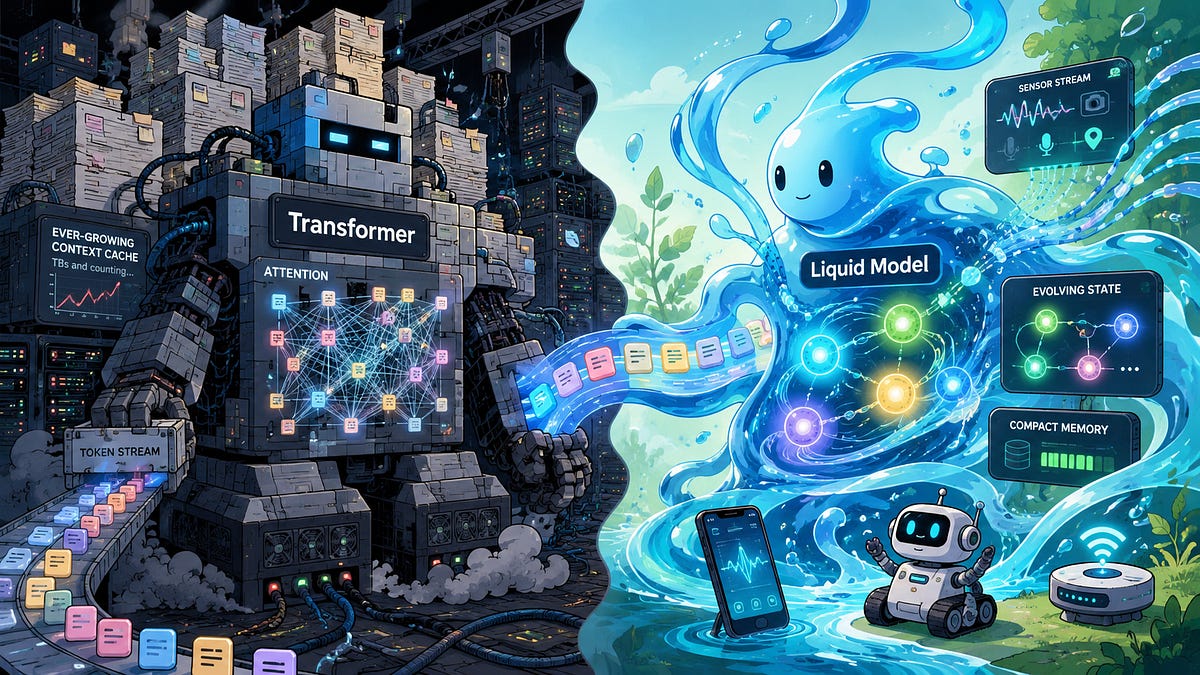
The Transformer’s physics of global interaction, while powerful, scales quadratically with sequence length. This means that as the context grows—and in many real-world applications, like long-form conversation, continuous monitoring, or complex agentic systems, context must grow—the computational and memory burden explodes. Serving these models, especially at the scale demanded by consumer-facing applications or edge devices, becomes a monumental, often prohibitively expensive, undertaking. It’s like trying to store every single thought you’ve ever had in a notebook the size of a city. Wonderful for recall, perhaps, but deeply impractical.
This is precisely where the burgeoning field of liquid models steps in, aiming to redefine the architecture of AI intelligence.
Think of it this way: the Transformer treats a sequence like a discrete set of points, each needing to be aware of all others. Liquid models, however, envision a more fluid, continuous interaction. Instead of a static attention matrix computed once, they propose dynamic, evolving internal states that mimic biological systems—systems that don’t re-evaluate their entire history for every new sensory input.
The core idea here is stateful, continuous processing. Rather than a hard cutoff or a fixed-size attention window, liquid models maintain a flowing, evolving internal representation of the input sequence. This means that as new data arrives, the model doesn’t need to re-process everything from scratch. It updates its current state, much like a living organism adapts to its environment without forgetting its entire past. This continuous adaptation is key to efficiency, especially for long-running or real-time tasks.
One of the most exciting manifestations of this research comes from the work on Liquid Neural Networks (LNNs). These aren’t your typical feed-forward or recurrent structures. LNNs are inspired by the dynamics of biological neurons, operating with differential equations that govern how their internal states evolve over time. This inherent time-dependency and continuous nature make them naturally suited for handling time-series data, sensor streams, and indeed, any sequential information where memory and adaptation are paramount.
“The Transformer is a brilliant architecture for cloud-scale intelligence. It is less obviously the final architecture for always-on, low-latency, private, embodied, on-device intelligence.”
This quote, from the original analysis, crystallizes the current AI landscape. Transformers excel in the data centers, powering massive LLMs. But what about the future? What about the AI that lives in your smart glasses, your autonomous car, or your personal robot assistant? These environments demand low power consumption, minimal latency, and on-device processing capabilities that the Transformer’s quadratic complexity struggles to deliver.
Liquid models, with their ability to efficiently manage and update state over long periods, offer a potential architectural bridge to this future. Imagine an AI that can continuously learn from your interactions throughout the day without requiring a constant uplink to a powerful cloud server. Imagine an autonomous vehicle that can adapt its driving strategy in real-time to unpredictable road conditions, not by re-analyzing every past second, but by smoothly updating its internal understanding of the situation.
Of course, this isn’t a simple flip of a switch. The Transformer’s success is built on a foundation of extensive research, tooling, and widespread adoption. Liquid models are still in their relative infancy. The engineering challenges in scaling them, developing efficient training methodologies, and building strong ecosystems around them are significant. Furthermore, achieving the same level of emergent capabilities—the complex reasoning and generation we’ve come to expect from LLMs—using a fundamentally different architectural paradigm will require breakthroughs in both theory and practice.
But the pressure is mounting. The dream of ubiquitous, intelligent AI—AI that is not only powerful but also pervasive and personalized—demands architectures that break free from the computational constraints of the Transformer. Liquid models, with their promise of continuous, stateful, and efficient processing, represent a crucial frontier in that pursuit. It’s a fascinating exploration, moving beyond the static snapshot of attention to a dynamic, flowing intelligence.
Will liquid models fully supplant Transformers? It’s too early to say definitively. But their emergence signals a vital architectural shift, a necessary evolution toward AI that can truly live and learn in our world, not just within the confines of massive server farms.
Why Does This Matter for Developers?
For developers, the rise of liquid models signals a potential shift in the tools and platforms they’ll be working with. If these models prove adept at on-device processing and continuous learning, expect to see new SDKs, frameworks, and deployment strategies emerge specifically for them. This could open up possibilities for building more responsive, personalized, and privacy-preserving AI applications that were previously infeasible with Transformer-based architectures. It’s a call to expand the toolkit beyond the current dominant paradigms.
Is This the End of the Transformer?
Not necessarily. The Transformer architecture is incredibly well-understood and has proven its worth in countless cloud-based applications. It’s likely to remain the go-to for large-scale, offline training and inference where computational cost is less of a bottleneck. However, for applications demanding real-time adaptability, low latency, and efficient on-device operation—think edge AI, robotics, and continuous monitoring systems—liquid models present a compelling, and potentially superior, alternative. The future probably involves a coexistence, with each architecture suited to different problem domains.
🧬 Related Insights
- Read more: FutureAI: Zero Code, 100% Hype – The April Fools App Exposing AI’s Big Lie
- Read more: TAO Token Tanks 18% as BitTensor’s Decentralization Dream Cracks Open
Frequently Asked Questions
What are liquid models in AI?
Liquid models are a class of AI architectures that aim to process sequential data using continuous, evolving internal states, drawing inspiration from biological systems. Unlike Transformers which rely on discrete attention mechanisms, liquid models update their state dynamically, making them potentially more efficient for long-running or real-time applications.
What are the advantages of liquid models over Transformers?
Key advantages include greater efficiency for long sequences, reduced computational and memory overhead for continuous processing, and better suitability for on-device or real-time AI applications. They are designed for ongoing adaptation rather than recalculating attention across vast historical data.
Are liquid models ready for widespread adoption?
While promising, liquid models are still an active area of research and development. They face engineering challenges related to scaling, training, and ecosystem support. Widespread adoption will depend on further breakthroughs and the development of strong tooling and frameworks.