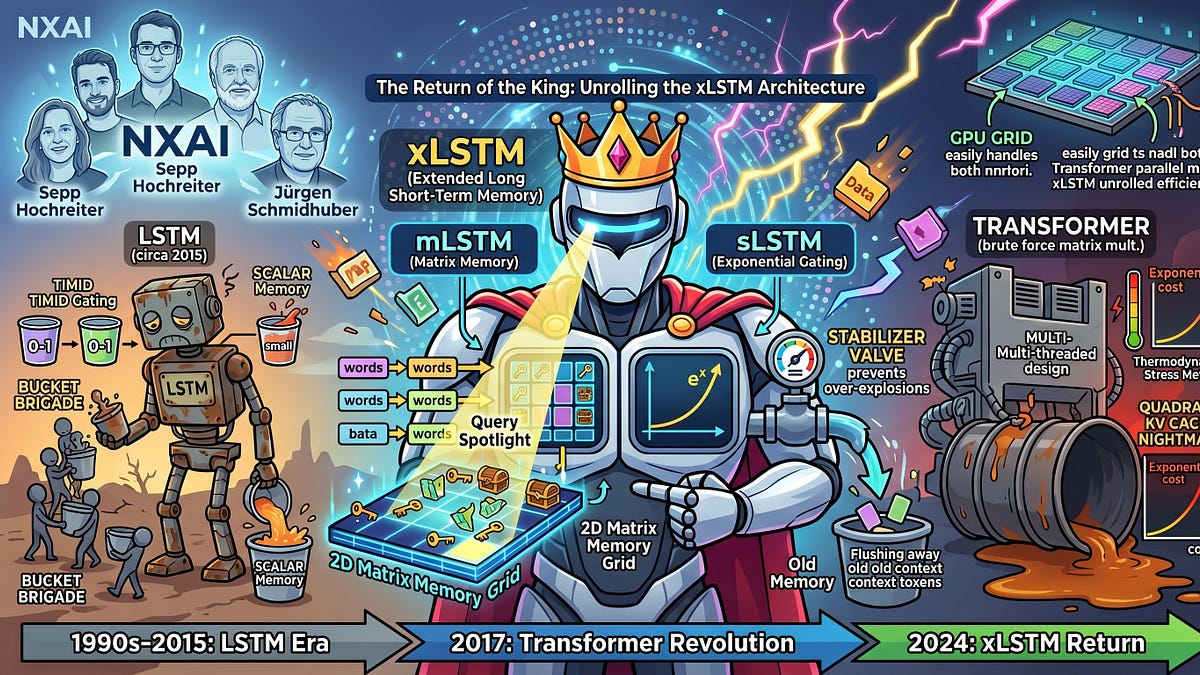
LSTMs. Back.
For a good chunk of the AI research community, the Long Short-Term Memory (LSTM) network was the model for sequence data. Invented decades ago, it was the sophisticated engine powering everything from early machine translation to speech recognition. It was elegant, it was powerful, and it was, for a long time, king. Then, in 2017, a paper dropped — “Attention Is All You Need” — and the world collectively tilted. Suddenly, the parallelizable, brute-force power of the Transformer architecture, with its attention mechanisms, became the new darling. It fit the hardware, it scaled, and it simply outperformed LSTMs on many benchmarks. We all moved on. Or so we thought.
But here’s the thing about foundational architectures: they rarely die, they just go dormant. And the xLSTM architecture, as detailed in a recent preprint, is the latest evidence of this cyclical nature in AI development. This isn’t just a minor tweak; it’s a fundamental reimagining of how we handle sequences, and it’s explicitly designed to address the perceived shortcomings of its Transformer successors, particularly in computational efficiency and memory usage over long contexts. The paper posits that by returning to the core strengths of recurrent neural networks — specifically the gating mechanisms of LSTMs — and marrying them with modern architectural insights, we can create a model that is both highly performant and significantly more economical.
The Ghost in the Machine: Why Recurrence Matters
The Transformer’s magic, as we know, lies in its self-attention mechanism. It allows the model to weigh the importance of different parts of the input sequence simultaneously. This is fantastic for capturing long-range dependencies, but it comes at a cost: quadratic complexity with respect to sequence length. For very long sequences, this becomes computationally prohibitive and memory-intensive. You’re essentially performing a massive matrix multiplication that grows exponentially.
xLSTM, on the other hand, aims to bring back the elegance of recurrence. It doesn’t process the entire sequence at once. Instead, it maintains a hidden state that is updated sequentially. Think of it like reading a book, where your understanding of the current sentence is built upon your understanding of all the previous sentences. The key innovation here, the paper argues, is not just bringing back the old LSTM, but enhancing it. They’ve introduced a novel state-space model approach within the recurrent structure, allowing for a more sophisticated handling of memory and state transitions. This allows the xLSTM to theoretically scale linearly with sequence length, a massive advantage for tasks involving extremely long documents or high-resolution time series.
“The architecture introduces a parallelizable recurrent mechanism, allowing the model to learn from sequences of arbitrary length while maintaining a constant memory and computational cost per step.”
This isn’t just academic navel-gazing. The claim here is that xLSTM can achieve performance comparable to, and in some cases exceeding, Transformers, but with a fraction of the computational resources. If true, this has profound implications for democratizing access to powerful AI models and for deploying them in resource-constrained environments, like edge devices or even just more modest research labs.
Unrolling the ‘Why’: A Shift in Architectural Philosophy
So, why now? Why are we seeing a resurgence of interest in recurrent architectures after years of Transformer-induced zeal? It’s a confluence of factors. Firstly, the limitations of Transformers for very long contexts have become increasingly apparent. While techniques like sparse attention and sliding window attention have emerged, they are often workarounds rather than fundamental solutions. Secondly, the AI hardware landscape, while still dominated by GPUs optimized for parallel matrix operations, is also seeing diversification. Novel hardware architectures that might better suit recurrent computations are on the horizon. Finally, and perhaps most importantly, there’s a growing realization that architectural diversity is a strength, not a weakness. Chasing a single paradigm, no matter how successful, can lead to blind spots.
My take is that this is less about the “return of the king” and more about a maturation of the field. We’ve exhausted the low-hanging fruit with Transformers and are now circling back to fundamental principles, armed with new insights and a broader understanding of computational trade-offs. It’s a sign of healthy evolution when established paradigms are questioned and when seemingly outdated ideas are re-examined through a modern lens. The original LSTM was a marvel of its time, but the xLSTM, by incorporating elements like state-space models and parallelizable recurrence, represents a significant leap forward.
Will xLSTM Replace Transformers?
It’s too early to declare the Transformer dead. Its ability to parallelize training across vast datasets is still a colossal advantage for many applications. However, the xLSTM architecture presents a compelling alternative, particularly for tasks where memory and computational efficiency are paramount. Think about processing entire books, lengthy scientific papers, or continuous real-time sensor data. The linear scaling claims of xLSTM are genuinely exciting and could unlock new frontiers in AI applications that are currently computationally infeasible.
We’re likely entering an era where different architectures will find their niche. Transformers will continue to dominate for tasks where massive parallelization is king, while xLSTMs could become the go-to for long-context, efficient processing. This isn’t a zero-sum game; it’s about building a more versatile AI toolkit. The xLSTM project is a proof to the enduring power of fundamental research and the human capacity to innovate by revisiting, rather than discarding, foundational concepts.
What This Means for Developers
For developers and researchers, this is an opportunity. Experimentation with xLSTM architectures is likely to become increasingly important. The ability to train models on longer sequences with less hardware means more accessibility. It suggests a future where large-scale sequence modeling isn’t confined to the hyperscalers. Keep an eye on the libraries and frameworks that will inevitably emerge to support this new wave of recurrent models.
🧬 Related Insights
- Read more: Why Big Finance Is Quietly Building Blockchain Infrastructure—and What It Means for Everyone Else
- Read more: LangChain Dev Builds IDE Agent That Kills Claude Code—And Hands You the Reins
Frequently Asked Questions
What is xLSTM?
xLSTM is a new neural network architecture that combines the strengths of Long Short-Term Memory (LSTM) networks with modern advancements to process long sequences efficiently.
Is xLSTM better than Transformers?
It depends on the task. xLSTM promises better efficiency and scalability for very long sequences, while Transformers excel at parallel processing and have broader existing support.
Will xLSTM replace my Transformer model?
Not necessarily. xLSTM offers a compelling alternative for specific use cases, particularly those requiring long context understanding and computational efficiency, but Transformers will likely remain dominant for many other applications.