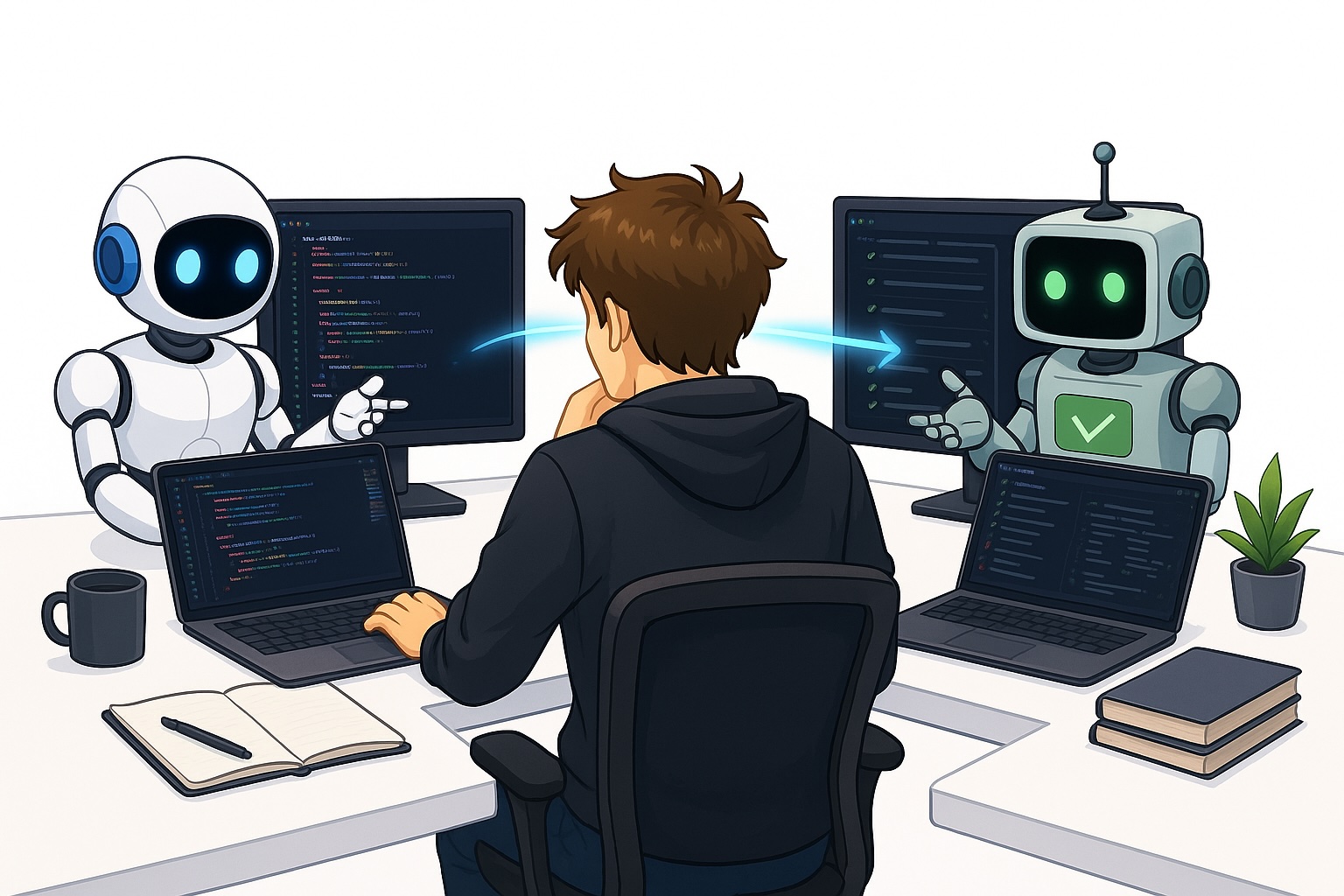
A junior developer commanding $6,500 a month? That’s the reality for one client’s web app feature work. Now, two AI coding powerhouses — Claude Opus 4.8 and Codex (GPT 5.5) — are stepping into the ring, aiming to prove if artificial intelligence can indeed supplant human capital at that price point.
The Pitch: AI as a Cost-Cutting Measure
The premise is starkly capitalist: identify a recurring high expense (a junior developer’s salary) and find a cheaper, more efficient alternative. The author of the original piece, clearly operating with a profit-maximizing directive, embarked on a direct comparison. The goal wasn’t just to see if AI could write code, but if it could do so competently enough to handle actual client feature development, thereby justifying the elimination of a human role.
This isn’t just about lines of code; it’s about market dynamics and the relentless pressure on businesses to optimize operational costs. In an environment where every dollar counts, the allure of AI-driven development is potent, promising not just savings but potentially faster iteration cycles.
Benchmarking the Bots: Opus vs. Codex
The critical question hinges on performance. How did these large language models, specifically trained for code generation, stack up? The report indicates a clear hierarchy emerged from the tests.
Claude Opus 4.8, the more advanced of the two models tested, appears to have taken a significant lead in generating functional and well-structured code. It’s not just about spitting out syntax; it’s about understanding context, adhering to best practices, and producing output that requires minimal human intervention. This is where the true value proposition of advanced AI coding assistants lies – reducing the debugging and refactoring burden that often eats into development time.
Codex, while still a formidable tool, seems to lag behind Opus in terms of raw capability and contextual understanding for this particular use case. This isn’t to say Codex is ineffective, but in a direct head-to-head against a leading-edge model like Opus, its limitations become apparent. The market for AI tools is evolving at breakneck speed; what’s cutting-edge today can be outpaced by tomorrow’s update. This suggests that staying competitive in AI development means constant vigilance and ongoing evaluation of tool performance.
The experiment aimed to determine if AI could handle actual client feature development, justifying the elimination of a human role.
Beyond the Code: The Human Element
Here’s the sticky part, the bit that gets glossed over in purely cost-benefit analyses: the human element. While Opus may have generated more functional code, the article hints at areas where human oversight remains indispensable. Developers aren’t just typists; they are problem-solvers, collaborators, and critical thinkers. They anticipate edge cases, architect complex systems, and communicate nuanced requirements.
Replacing a developer entirely with AI, even a highly capable one, overlooks the iterative nature of software development that involves human intuition, creativity, and nuanced communication. Can AI truly grasp a vague business requirement and translate it into elegant, scalable code without a human intermediary to clarify and guide? The data from this experiment suggests it’s not a simple ‘yes’ or ‘no’. It’s more of a ‘yes, but with caveats.’
The cost savings are undeniable, especially when juxtaposed against a $6,500 monthly payroll. However, the long-term implications for product quality, team dynamics, and innovation are less clear-cut. This isn’t just about replacing a task; it’s about potentially altering the very fabric of how software is conceived, built, and maintained.
The Verdict: Efficiency Gains, But Not a Total Takeover (Yet)
So, can you replace a $6,500/month developer with Claude Opus 4.8? The evidence points to a qualified ‘yes’ for certain tasks, particularly repetitive feature implementation and boilerplate code generation. The efficiency gains and cost reductions are substantial and undeniable. Businesses looking to trim fat will undoubtedly see this as a major win.
However, the narrative of complete replacement feels premature. The nuanced, often messy, process of software development still benefits immensely from human insight, debugging prowess, and architectural foresight. This experiment provides a crucial data point, a snapshot of AI’s current capabilities in coding, but it’s far from the final chapter in the story of AI’s impact on the software development industry. The market will demand more sophisticated AI, and human developers will need to evolve their roles, focusing on higher-level problem-solving and AI oversight.
The real question isn’t if AI can write code, but how it integrates into a human-led development workflow to maximize both efficiency and quality. The $6,500 developer may be on notice, but the need for skilled human oversight isn’t disappearing anytime soon.
🧬 Related Insights
- Read more: Docker Commandos Deal Cards Against CVEs: The Arcade That’s Sneakily Genius
- Read more: