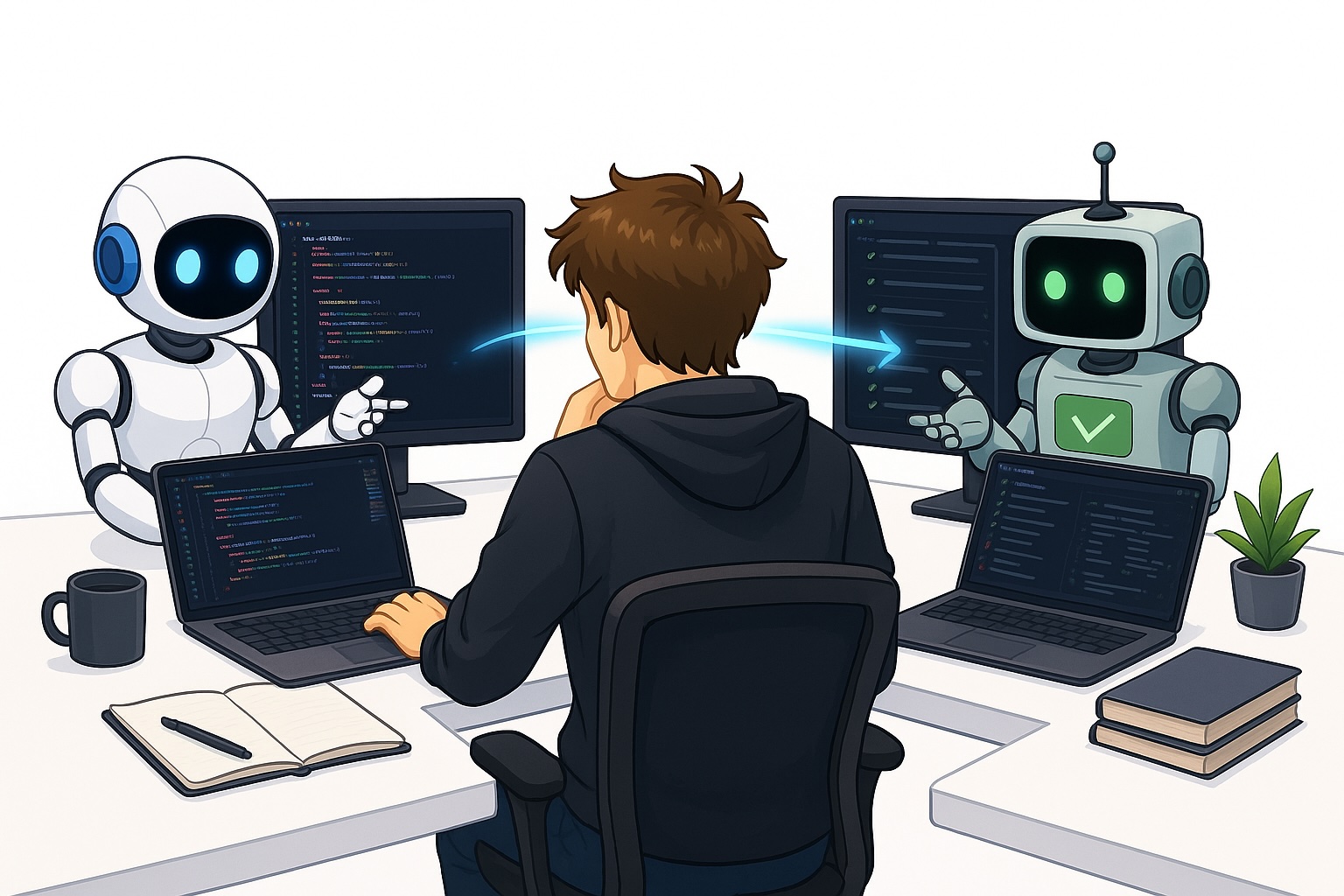
Everyone expected AI to write our code. Just feed it a prompt, and poof, a fully functional application appears. We were told these magical boxes would democratize development, letting anyone with an idea build the next big thing. And here we are, with Claude Code and Codex, two heavyweights vying for developer attention. But the reality? It’s not quite the frictionless utopia the PR departments promised. Instead, it’s a slightly messier, more nuanced dance where understanding why and when to use each tool is the actual superpower.
Why Are We Even Talking About This? The AI Coding Assistant Gold Rush
Look, the hype around AI coding assistants has been deafening. Suddenly, every company with a server farm is promising to slash development time by 50%, boost productivity by 300%, and cure your morning coffee craving. It’s a dizzying parade of buzzwords and inflated promises. But beneath the glossy marketing, there’s a fundamental question many developers, and frankly, anyone watching this space, have been asking: who is actually making money here, and are these tools really making our lives easier, or just more complicated?
The author of the piece I’m dissecting here seems to think they’re indispensable. They’re applying these coding agents to everything – setting up budgets, drafting emails, even, gasp, creating PowerPoints. This isn’t just about writing code anymore; it’s about offloading any task that involves a computer. The idea is that instead of wading through APIs or manually configuring frameworks, you just hand the keys to your AI assistant. It’s a compelling vision, for sure. But is it realistic for the average coder, or just for someone with a dedicated Claude subscription and an axe to grind against manual tasks?
Claude Code: The Planning Prodigy or Just Fancy UI?
When it comes to Claude Code, the author leans heavily on its supposed robustness, its knack for planning, and its almost uncanny ability to ask clarifying questions. It’s painted as the primary driver, the one you turn to when you’re deep in the trenches of coding. Features like the recap at the bottom of the chat – honestly, a solid win if you juggle a dozen tabs – and the ability to create worktrees on startup are highlighted. These aren’t exactly earth-shattering innovations, but they do suggest a tool that’s thinking a bit more about the developer’s workflow.
Then there’s ‘Workflows,’ a feature that allows for more tokens to tackle complex migrations. This is where things get interesting. If Claude Code can genuinely handle large-scale refactoring or complex migrations with more reliability than a human (or a less sophisticated AI), then the subscription fee starts to look less like a luxury and more like a necessary investment. The author even throws in a dig at OpenAI’s desktop app, suggesting Claude’s UI is simply better designed. For non-technical users, the recommendation is clear: use Claude. It’s a strong endorsement, but one that conveniently glosses over the ongoing stability issues.
Claude Code is ahead on the features and usually publishes the best features first. In some scenarios, Codex implements those features at a later point.
This quote, in particular, drips with bias. It’s a classic ‘our product is better because we innovated first’ argument. While true that feature parity isn’t instant, it ignores that Codex might be more reliable or better integrated into existing developer ecosystems. It’s a promotional statement masquerading as an objective observation.
Codex: The Reliable Backup or a Genuine Contender?
Ah, Codex. The author frames it primarily as a fallback when Claude Code decides to take an unscheduled nap. And let’s be honest, the uptime issues with Claude Code are apparently significant enough to warrant a dedicated mention. Approaching 99.0% uptime might sound good on paper, but for a tool you’re relying on for critical development tasks, it’s frankly abysmal. A few percentage points off can mean days of lost productivity.
But Codex isn’t just Claude’s understudy. It’s lauded for its performance in code reviews – a task that, let’s face it, can be mind-numbingly tedious for humans. Powering OpenClaw bots and getting work done faster in ‘fast mode’ are also cited as key reasons for choosing Codex. This implies that Codex, while perhaps less flashy with its feature roadmap, offers tangible benefits in specific, high-value areas. It’s the workhorse, the reliable tool that gets the job done, even if it’s not always the first to market with the latest bells and whistles.
The Real Power Play: How to Combine Them (If You Must)
The author’s core argument, and the most valuable takeaway from this piece, is that the true power lies not in picking a single winner, but in strategically deploying both. It’s about recognizing that Claude Code might be your planning guru and feature-rich companion for exploratory coding, while Codex steps in for strong code reviews or when Claude’s servers decide to go on vacation. This isn’t just about having a backup; it’s about leveraging the distinct strengths of each model to create a more resilient and efficient development pipeline.
The technique they hint at, one that yields ‘incredibly good results’ and helps build ‘very strong code,’ is the real meat. It suggests that these tools aren’t meant to replace human oversight but to augment it. The best AI coding assistants don’t just churn out code; they act as intelligent collaborators, prompting us to think more critically about our own designs and implementations.
Is This Just a Subscription Upsell?
Let’s circle back to that initial skepticism. When I see someone advocating for a paid subscription to one AI assistant over another, and then suggesting you also need a secondary one for when the first one inevitably falters, a little alarm bell goes off. Who is profiting from this complex ecosystem? Primarily, the companies selling access to these models. The ‘maximum coding power’ isn’t necessarily about achieving some platonic ideal of developer efficiency; it’s about getting developers hooked on a suite of tools that require ongoing payment.
My two cents? These tools are powerful, yes. They can accelerate certain tasks and offer novel ways to approach problems. But they’re not a magic bullet. The real skill lies in understanding the limitations of each AI, knowing when to trust their output, and, crucially, when to roll up your own sleeves. The best code still comes from a human who understands the problem, the context, and the long-term implications – the AI is just a very, very sophisticated autocomplete with a tendency to hallucinate. And as for PowerPoint? Stick to the mouse and keyboard.
The Power of Augmentation
This dance between Claude and Codex, between planning and execution, between innovation and reliability, is emblematic of where AI in development is heading. It’s not about replacement; it’s about augmentation. The tools that win will be those that smoothly integrate into existing workflows, offer clear ROI, and, crucially, don’t suffer from crippling downtime. The others? They’ll be the footnotes in the next AI hype cycle.
🧬 Related Insights
- Read more: Netflix’s Shadow Ops: The Real Engineering Behind Safe Automation at Scale
- Read more: Gemma 4’s Day-One Reality Check: Community Exposes the Cracks in Google’s Pitch
Frequently Asked Questions
What are the main differences between Claude Code and Codex? Claude Code is generally favored for its planning capabilities, interactive questioning, and more advanced CLI features like Workflows. Codex is highlighted for its performance in code reviews and reliability as a backup when Claude Code is unavailable.
Should I pay for an AI coding assistant? It depends on your workflow and budget. The article suggests that combining Claude Code and Codex can offer significant advantages, implying that a paid subscription might be worthwhile for serious developers seeking maximum efficiency. However, weigh the cost against the actual time saved and the reliability of the service.
Will AI coding assistants replace human programmers? Most experts agree that AI assistants are more likely to augment rather than replace human programmers. They excel at repetitive tasks, code generation, and code review suggestions, freeing up developers to focus on higher-level design, problem-solving, and complex architectural decisions.