The coffee mug still had a faint ring from yesterday’s lukewarm brew on the desk.
Look, I’ve been swimming in Silicon Valley’s hype for two decades, and the latest pronouncements from Amazon about securing its Bedrock AgentCore Gateway with something called an “authorization code flow” sounds suspiciously like repackaged tech jargon. They’re talking about letting AI assistants like Kiro IDE talk to enterprise services (what they call MCP servers) without letting just any rogue bot in. Sounds good on paper, right? But who’s actually paying for this, and what does it mean beyond a more complicated handshake for your AI overlord?
Who Needs Fancy Handshakes for AI?
Apparently, organizations are getting antsy. They’ve got these slick AI coding buddies — think Kiro IDE, which sounds more like a new vape flavor than a development tool — that are supposed to be interacting with sensitive backend systems. Naturally, Amazon’s AgentCore Gateway is positioned as the gatekeeper, the bouncer at the AI club, ensuring only authenticated, identity-verified AI agents get through to these so-called MCP servers. It’s all about preventing unauthorized access, which, let’s be honest, is a legitimate concern in a world where bots are getting smarter by the minute.
The OAuth Dance: A Familiar Tune
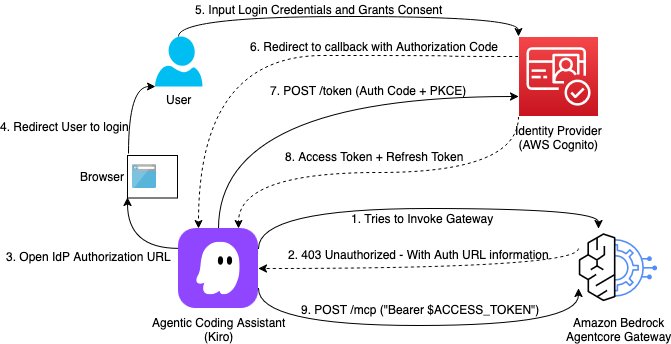
At its core, this isn’t exactly quantum physics. It’s an old friend: OAuth 2.0, specifically the authorization code flow. You’ve probably seen this before when you log into a website using your Google or Facebook account. The process involves your AI assistant (the client) getting an authorization code from an identity provider (like Okta or Amazon Cognito), and then trading that code for an access token. This token is supposed to prove that a real user — or at least, an AI acting on behalf of a real user — is making the request. The AgentCore Gateway then acts as the ‘resource server,’ checking this token before letting the AI get its digital grubby mitts on your precious MCP resources.
It’s like this:
The Gateway detects that the request lacks a valid token and responds with an HTTP 401, including a
www-authenticateheader pointing to the Gateway’s OAuth Protected Resource Metadata endpoint (.well-known/oauth-protected-resource). This follows the MCP specification’s Protected Resource Metadata (PRM) pattern.
This dance ensures that every command an AI spits out to your tools has a traceable, verified origin. No more anonymous AI mischief, theoretically.
Is This Just More Cloud Bloat?
The real question for those of us who remember the dot-com bust and the subsequent Web 2.0 boom is: how much of this is genuine innovation and how much is Amazon layering more complexity — and thus, more billable services — onto its cloud? AgentCore itself is presented as a “fully managed service.” That’s tech-speak for “we’ll handle it, and you’ll pay us for it.” The AgentCore Gateway is the “centralized entry point,” the “resource server.” More managed services, more control for Amazon, and more recurring revenue. It’s a business model as old as time, just wrapped in an AI bow.
For developers integrating Kiro IDE or similar tools, this means another layer to configure. You’ll be fiddling with your identity provider, setting up scopes, and making sure the PKCE challenge (a security mechanism to prevent code interception) is properly handled. It’s not necessarily bad, but it’s certainly not the ‘just plug it in and go’ fantasy many AI pitches suggest.
The architecture diagram provided, showing the IdP, AI client, and MCP server interactions, looks like any standard OAuth flow. The novelty, if you can call it that, is the explicit integration into Amazon’s AgentCore for these AI agentic assistants.
Why Does This Matter for Developers?
If you’re building applications that use AI agents to interact with your backend systems, this setup is going to become your new reality, at least if you’re playing in the Amazon ecosystem. You’ll need to understand how the authorization code flow works, how to configure your chosen Identity Provider (IdP) to issue the correct tokens, and how the AgentCore Gateway will validate them. This isn’t just about writing code; it’s about understanding security protocols and enterprise identity management.
It’s an added layer of operational overhead. Think of it as requiring a digital passport for your AI before it can even whisper sweet nothings to your database.
The Bottom Line: Security or Vendor Lock-in?
Amazon Bedrock AgentCore’s foray into securing AI agent interactions with the authorization code flow is a sensible step for enterprises. It addresses a real need for authenticated access. However, it’s crucial to remember that “fully managed” often translates to vendor lock-in and a steady stream of revenue for the provider. The complexity introduced is justifiable for strong security, but the industry needs to remain vigilant about whether these solutions are truly simplifying development or just creating more complex paths to cloud provider services.
So, while your AI coding assistant might get a more secure connection, your IT department will get a few more late nights configuring the new setup. And Amazon? They’ll get another happy customer, tied a little tighter into their ecosystem.
🧬 Related Insights
- Read more: Fortinet’s EMS Zero-Day: Hackers Strike While Patch Lags
- Read more: Relvy AI: The Runbook Revolution Ending On-Call Hell for Devs
Frequently Asked Questions
What does AgentCore Gateway actually do?
AgentCore Gateway acts as a secure entry point for AI agents to interact with enterprise services (MCP servers). It verifies the identity of the AI agent or its associated user before allowing access, essentially functioning as a security checkpoint.
Will this setup make my AI coding assistant more vulnerable?
No, the goal of this setup is to increase security. By implementing an OAuth authorization code flow, it ensures that AI requests are authenticated with valid user identity tokens, reducing the risk of unauthorized access to sensitive systems.
Is this process difficult for developers to set up?
It adds complexity compared to simpler integrations. Developers will need to configure their identity provider, understand OAuth flow mechanics, and ensure proper integration with the AgentCore Gateway and the AI client. While not insurmountable, it requires a solid understanding of security protocols.