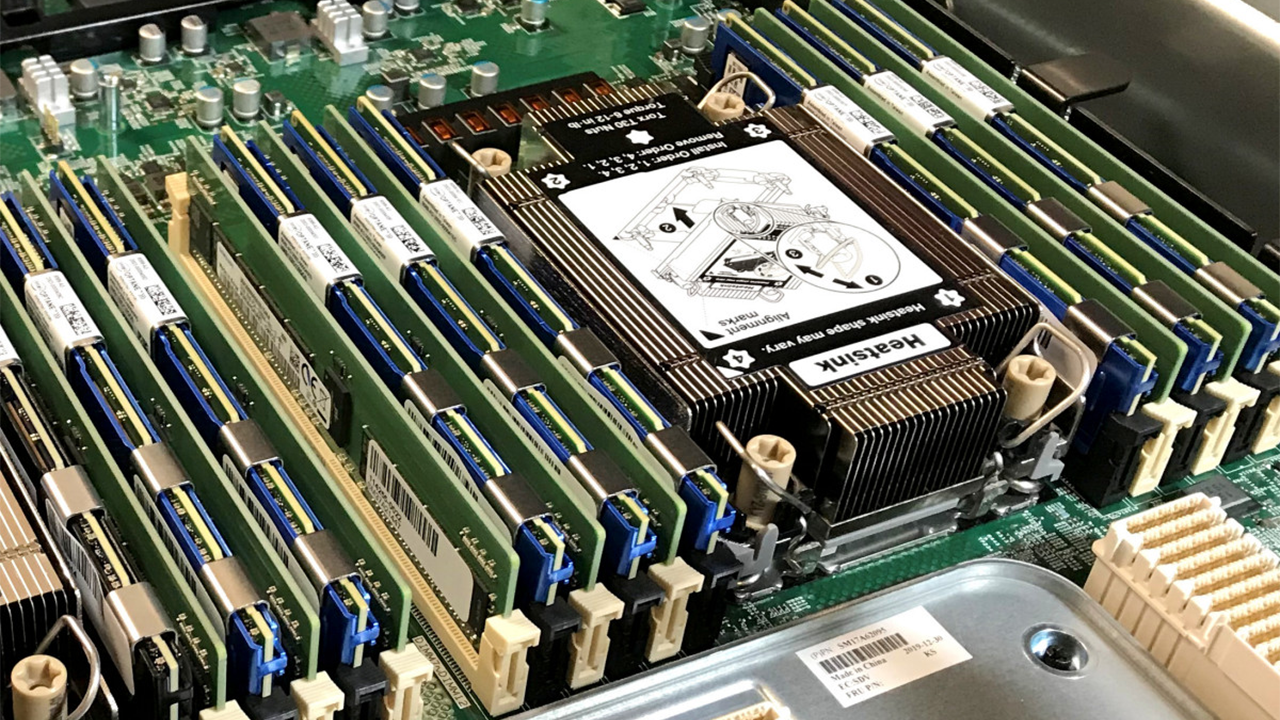
The fan whirred. A single GPU blinked. And a behemoth model, once confined to cloud behemoths, was chugging along on a shoestring budget. That’s the scene, folks.
A Redditor, bless their DIY heart, has managed to coax a 1-trillion-parameter LLM – Kimi K2.5, no less – to run on a decidedly unglamorous workstation. The secret sauce? A mountain of used Intel Optane Persistent Memory DIMMs. We’re talking 768GB of it.
It’s a stunt that’s got the AI hardware world buzzing. Not because it’s fast – far from it, clocking in at a glacial ~4 tokens per second – but because it’s possible on hardware that wouldn’t make a serious enterprise data center sweat.
Is This the Future of Local LLMs?
APFrisco, the architect of this budget marvel, details the build on the Local LLaMA subreddit. The key was snagging Intel’s discontinued Optane Persistent Memory, which lives in that awkward space between speedy DRAM and slower SSDs. While it’s not as zippy as your usual RAM, it’s significantly cheaper for mass capacity. And for LLM inference, it turns out, that middle ground is surprisingly sweet.
“Given the fact that this is a trillion-parameter frontier-class model running on such a limited hardware budget, I would consider it to be a great success.”
APFrisco’s setup isn’t exactly cutting-edge. A Xeon Gold CPU. A single RTX 3060 with a stingy 12GB VRAM. Plenty of Optane. The DDR4 RAM? It’s relegated to cache duty. The heavy lifting, or rather, the slight shuffling, is split between that lone GPU and the CPU, all orchestrated by llama.cpp.
This isn’t a “don’t try this at home” situation so much as a “please, for the love of your sanity, don’t expect miracles” scenario. But it’s precisely these kinds of hacks that push the boundaries. It highlights how much computational muscle we can wring out of second-hand or niche hardware when the will is there.
Optane’s Swan Song, CXL’s Overture
Intel killed Optane. A shame, really. It was a niche product, sure, but it served a purpose. It filled a gap. And now, it’s being resurrected, in spirit at least, by some ingenious tinkerers. This build is Optane’s dying gasp of relevance, proving that even retired tech can find new life in the AI revolution.
The real takeaway here isn’t just about Optane. It’s about the chasm in memory technology. We need more affordable, high-capacity, byte-addressable memory for these massive models. The industry is looking to CXL (Compute Express Link) to bridge that gap, promising pools of memory that could dwarf current offerings. Think less about cramming Optane into your rig and more about entire memory arrays designed for AI.
This build is a stark reminder that the cutting edge isn’t always the most expensive. Sometimes, it’s just the most creative. And with a trillion parameters humming along at 4 tokens a second, it’s a noisy kind of creativity.
🧬 Related Insights
- Read more: React Server Components: Three New CVEs Expose DoS Crashes and Source Code Leaks
- Read more: Eywa: AI Agents Break Free From Text Limits [New Framework]
Frequently Asked Questions