Are we sure anyone’s actually calculating the societal return on this AI spending spree?
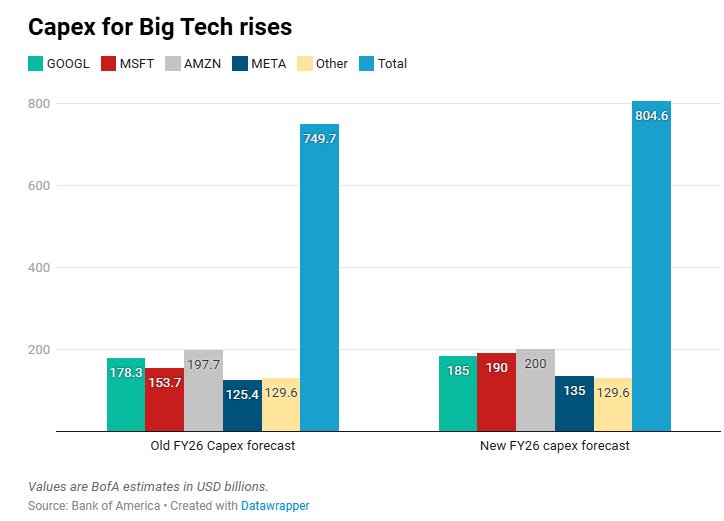
Here’s the thing: the numbers being thrown around for Artificial Intelligence investment are staggering. We’re talking $1 trillion in projected total spending by 2027, a figure bandied about by Wall Street analysts and reported by outlets like CNBC. This isn’t just BigTech flexing its financial muscles, either. Factor in the aggressive expansion plans of players like Oracle, CoreWeave, xAI, and a host of emerging ‘Neo Clouds’ — many of them backed by considerable debt, some quite speculative — and the figure balloons. Oracle’s datacenter build-outs, for instance, rely heavily on its own substantial debt and third-party financing. Crusoe, eyeing a potential 2026 IPO, exemplifies the aggressive, albeit smaller, players in this capital expenditure race. This relentless acceleration in CapEx directly correlates with an insatiable demand for compute power, particularly for inference tasks. Every trending AI gimmick, every ‘tokenmaxxing’ fad, translates into more tokens processed, more GPUs humming at peak capacity. Corporate bonds and VC funding are, in essence, subsidizing this immense burn rate. The true figures remain elusive, but the snowball effect is undeniable, designed to legitimize the immense capital expenditures by showcasing corresponding increases in BigTech cloud computing and ad revenue. The actual ROI for society, however? That’s considerably more uncertain and, frankly, speculative. What tangible productivity gains can we realistically anticipate, and how will that ROI trickle down into the broader economy and labor market? The implications for jobs are, at best, ambivalent, uncertain, and mixed. This brings us to some rather dizzying op-eds lately.
AI Job Loss or Jevons Paradox? The Data Tells a Different Story
Consider the customer service sector. The narrative often pits AI against human jobs, suggesting a net loss. However, evidence points to a potential increase in labor demand, a phenomenon echoing Jevons Paradox. Torsten Slok of Apollo highlights a striking case study: the Philippines. Nearly two million workers there are now employed in call centers, a number that has climbed annually since 2016, continuing through the AI boom. This isn’t counterintuitive; it’s Jevons Paradox in action. As AI makes individual customer interactions cheaper and faster, companies aren’t reducing their service footprint. Instead, they’re expanding it. Lower per-interaction costs translate directly into serving more customers, opening new communication channels, and tapping into previously unreachable markets. The technology ostensibly poised to shrink the industry is, in this instance, fueling its growth. The labor economics of agentic AI remain a complex equation. While some initially predicted a slump in software engineer hiring, demand has, in fact, begun to rebound. It’s worth questioning whether AI is truly disrupting jobs or simply shifting the landscape.
It’s easy to get caught up in the AI hype, but let’s inject some perspective. Demographic shifts and immigration patterns in the U.S. labor market have demonstrably had a more significant impact on job creation over the past few years than AI’s current footprint. We’re seeing a persistent low-hire environment. Aging populations and reduced immigration rates could indeed dampen job creation in the United States between 2026 and 2030, irrespective of AI’s task-automation capabilities. Healthcare, as it stands, remains the principal driver of employment growth. Yet, paradoxically, many major tech corporations are simultaneously conducting layoffs, ostensibly to offset their substantial investments in AI infrastructure. Several pieces in the New York Times have caught my attention regarding the future of work, and the so-called ‘abundance bros’ seem to have gotten a significant portion of their thesis both right and wrong. In the customer success example, increased efficiency appears to be driving more human and AI interactions due to reduced costs. Does Jevons Paradox offer some respite from the pain of declining demand for entry-level positions, or does it merely displace those roles, potentially accelerating their migration to other global regions?
Is AI Augmenting New Business Formation?
Something interesting is happening at the frontier of entrepreneurship. Sectors exhibiting the highest rates of AI adoption are also demonstrating the strongest growth in new business applications since 2022. This suggests that AI is actively lowering the barriers to entry for aspiring founders. Take a look at the chart below. Given the increasing difficulty faced by recent college graduates, particularly Gen Z, in navigating the traditional job market, many are turning to entrepreneurship, often enabled by AI. Gen Z, having grown up immersed in digital technologies, already possesses a higher degree of entrepreneurial curiosity, and the current U.S. labor market dynamics appear to be pushing them further in that direction. While social media buzzes with claims of AI empowering solopreneurs, the tangible data points toward a broader trend of AI lowering the startup threshold.
Sectors with the highest AI adoption rates have also seen the strongest growth in new business applications since 2022, showing that AI is lowering the barriers to starting a company, see chart below.
This trend, if sustained, could redefine economic growth models, shifting emphasis from large corporate monoliths to a more distributed network of AI-powered ventures. The challenge, then, becomes how to support and scale these nascent businesses effectively. It’s not just about the technology; it’s about fostering an ecosystem that can translate AI-driven innovation into sustainable economic activity. The question remains whether this wave of entrepreneurial activity will create genuinely novel economic opportunities or simply replicate existing ones at a lower cost, potentially impacting wage growth across the board. The long-term societal benefit hinges on this distinction.
The Unseen Costs of the Compute Rush
While the headline figures for AI spending paint a picture of unbridled growth, the underlying economics are fraught with assumptions. The massive capital expenditures on AI infrastructure – compute, power, cooling – are predicated on future revenue streams that are, to a degree, still theoretical. Companies are betting heavily that the demand for AI-driven services will continue its exponential trajectory, justifying the current frenzy of datacenter construction and hardware acquisition. However, the energy consumption alone represents a significant environmental and economic cost that isn’t always prominently featured in these analyses. Furthermore, the concentration of compute power within a few dominant players raises antitrust and competitive concerns. What happens when the cost of AI inference remains prohibitively high for smaller entities, stifling broader innovation? This ‘compute rich’ environment could inadvertently create new digital divides, reinforcing existing market power rather than democratizing AI capabilities. The narrative of AI as a universally accessible tool begins to fray when confronted with the sheer scale of investment required to operate at the cutting edge.
🧬 Related Insights
- Read more: Nacha’s Twin Deadlines Hit: Banks Scramble for Real-Time ACH Fraud Fixes
- Read more: Sales Teams Get Real AI Muscle: Why Specialized Models Beat LLM Wrappers
Frequently Asked Questions
What does the $1 trillion AI Capex projection actually cover? This projection encompasses massive investments in AI hardware (GPUs, TPUs), cloud infrastructure, datacenter construction, power, and cooling, primarily driven by BigTech and specialized AI cloud providers. It’s the cost of building the foundational compute power for advanced AI.
Will AI actually create more jobs than it destroys? Evidence suggests AI’s impact on jobs is complex. While some roles may be automated, AI’s efficiency gains can also lead to increased demand for services (Jevons Paradox) and foster new business formation, potentially creating different types of jobs. The net effect is still debated and depends heavily on sector and adaptation.
How does AI adoption impact new business formation? Sectors with higher AI adoption rates have seen a significant increase in new business applications, indicating that AI is lowering the barriers to entrepreneurship and enabling individuals to start companies more easily and potentially with fewer resources.