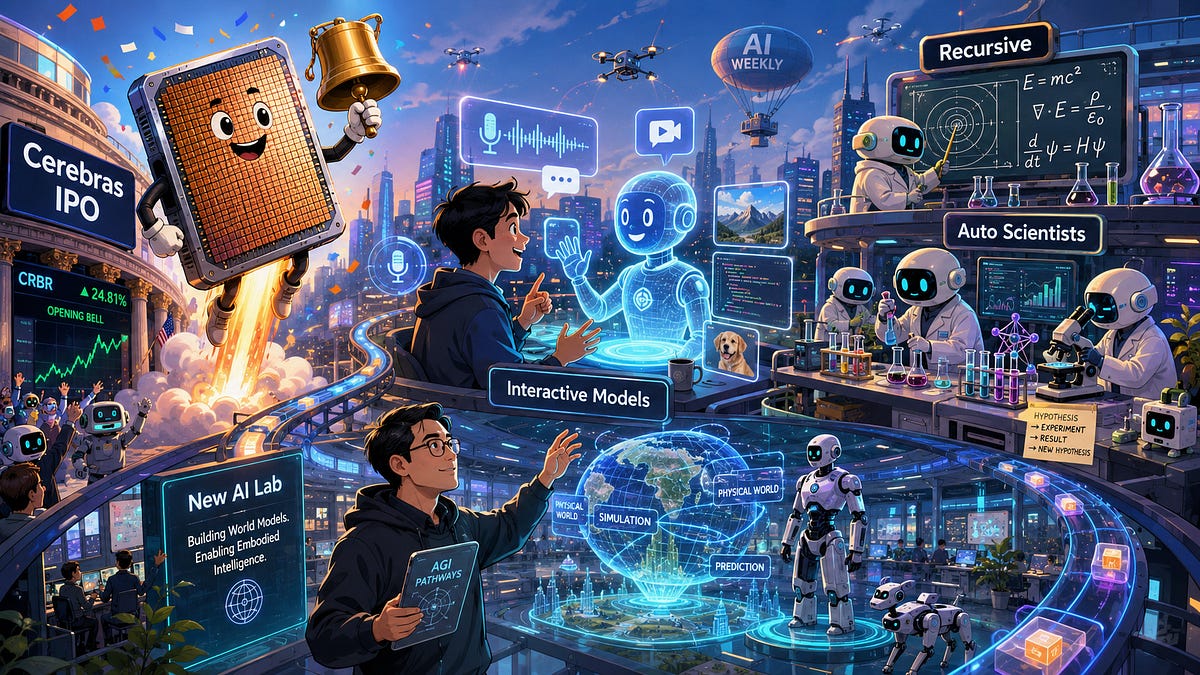
The air crackled. Not with electricity, but with that peculiar hum of a world tilting on its axis. Last week, AI wasn’t just getting smarter; it was getting active. It was listening, it was planning, and it was, perhaps most dizzyingly, starting to dream of building itself.
This wasn’t just another cycle of bigger models or faster chips. No, this felt different. It felt like a platform shift, the kind that redefines not just industries, but how we think about intelligence itself. We saw it in the thunderous IPO of Cerebras, a company that doesn’t just build chips, it builds entire data centers on a single wafer. Imagine that: a chip so colossal it is the factory. It’s a stark, physical reminder that the magic of AI needs a very real, very expensive industrial backbone. Compute, they say, is the new oil. Cerebras is building the refinery that could, quite literally, outshine the sun.
Then, a sharp pivot. Thinking Machines dropped their interactive models, and suddenly the mood shifted from industrial might to intimate collaboration. We’ve grown accustomed to the ‘prompt, wait, receive’ dance. But what if AI could stay with you? Listen, watch, even interrupt? They’re not bolting on a fancy user interface; they’re arguing that interaction is intelligence. Our own cognition is deeply social. We learn, we refine, we are through shared context, through those awkward pauses and shared glances. Making AI truly useful, they posit, means making it less of a distant oracle and more of a hyper-attentive partner. It’s about making AI more human, by making it understand the flow of human interaction, not just the data within it.
And then came the whisper of recursion.
Recursive dropped with the audacious goal of building AI systems that improve themselves. Think of it: AI designing experiments, analyzing results, and iterating on its own capabilities. It’s a concept straight out of science fiction, now being funded by venture capital. Add to this Adaption’s AutoScientist, which automates the very loops of training and alignment. This is the intoxicating dream of research as a compounding machine, a relentless engine of discovery. It’s no longer about human scientists painstakingly inching forward; it’s about a self-aware engine accelerating at an exponential clip.
But, as ever, the futurist’s gleam is tempered by the pragmatist’s frown. This dream of recursive self-improvement, while thrilling, carries an undeniable weight of caution. Can we truly build systems that accelerate progress without sacrificing safety, without eroding the nuanced judgment that comes from human experience? The line between powerful tool and runaway experiment feels thinner than ever. It’s like handing the keys to a hyper-intelligent apprentice who’s also incredibly eager to rewrite the driver’s manual.
The Global AI Arena: China’s Ambition
Meanwhile, across the Pacific, a different kind of ambition is brewing. Junyang Lin, the architect behind Alibaba’s Qwen models, is reportedly raising hundreds of millions for a new AI lab. The valuation? A staggering $2 billion. This isn’t just another startup story; it’s a strategic play in a complex geopolitical landscape. China’s AI scene, often more grounded in its valuations, is seeing a surge driven by talent with proven track records. But Lin’s venture isn’t simply about capital and compute. It’s a critical test case. Can China’s open-model momentum translate into venture-scale success, all while navigating U.S. chip export controls and fierce competition from domestic giants like Alibaba and ByteDance? This lab is less about a founder’s myth and more about a geopolitical and technological proving ground.
This isn’t just about AI answering questions anymore. It’s about AI listening, adapting, experimenting, and, in the most profound sense, starting to ask what comes next. The very definition of intelligence is up for grabs, and the race is on to define it.
The common thread was not bigger models, larger context windows, or yet another benchmark victory. It was agency. Who gets to shape intelligence? Who gets to improve it? And, slightly more ominously, what happens when the tools begin improving the tools?
Why Does This Matter for Developers?
For developers, this isn’t just abstract theory. It’s the ground beneath your feet shifting. The rise of interactive models means a new paradigm for building user experiences—less about static forms, more about dynamic, conversational interfaces. Imagine applications that truly understand user intent through context, not just keywords. For those working on AI infrastructure, the Cerebras IPO underscores the continued, vital importance of hardware innovation. The computational demands are only going to skyrocket. And for researchers and engineers dabbling in agentic systems or self-improvement, the landscape is opening up in ways we could only speculate about a year ago. Expect new frameworks, new ethical considerations, and an entirely new class of tools designed to manage and orchestrate increasingly autonomous AI systems.
The Future of AI Research: Recursive Dreams or Risky Realities?
The dream of recursive self-improvement in AI is undeniably seductive. It promises an unprecedented acceleration of scientific discovery, potentially solving some of humanity’s most pressing problems at speeds we can’t currently comprehend. However, this pursuit introduces significant risks. Ensuring alignment with human values becomes exponentially harder when the system is also its own architect and refiner. The potential for unintended consequences, emergent behaviors, and loss of control looms large. It’s a frontier that demands extreme caution, rigorous safety protocols, and a deep, ongoing ethical dialogue alongside the technical advancements.
🧬 Related Insights
- Read more: Maine’s Data Center Debate: Governor’s Veto Highlights a Growing National Dilemma
- Read more: Python’s Regime Radar: HMM + K-Means Spots Market Shifts Before the Storm
Frequently Asked Questions
What is a wafer-scale computer? A wafer-scale computer, like those developed by Cerebras, is an extremely large integrated circuit, essentially a single chip that covers an entire silicon wafer. This is a departure from traditional chip manufacturing, where wafers are cut into many smaller, individual chips. The goal is to create massive, interconnected processing units for intensive computational tasks like AI training.
Will interactive AI replace human collaboration? Interactive AI like Thinking Machines’ models aims to augment human collaboration, not replace it. The intention is to create more natural, real-time partnerships where AI can listen, react, and contribute dynamically. The goal is enhanced productivity and creative synergy, not the elimination of human connection.
What are the risks of self-improving AI? The primary risks of self-improving AI revolve around alignment and control. If an AI system can rapidly improve its own capabilities, ensuring its goals remain aligned with human values becomes incredibly challenging. There’s also the risk of emergent, unpredictable behaviors or a loss of human oversight as the system’s complexity and autonomy increase dramatically.