Have you ever stopped to think about how AI actually thinks? We marvel at its ability to churn out prose, code, and complex analyses, but beneath the surface, a fundamental limitation has been gnawing at the edges of the field.
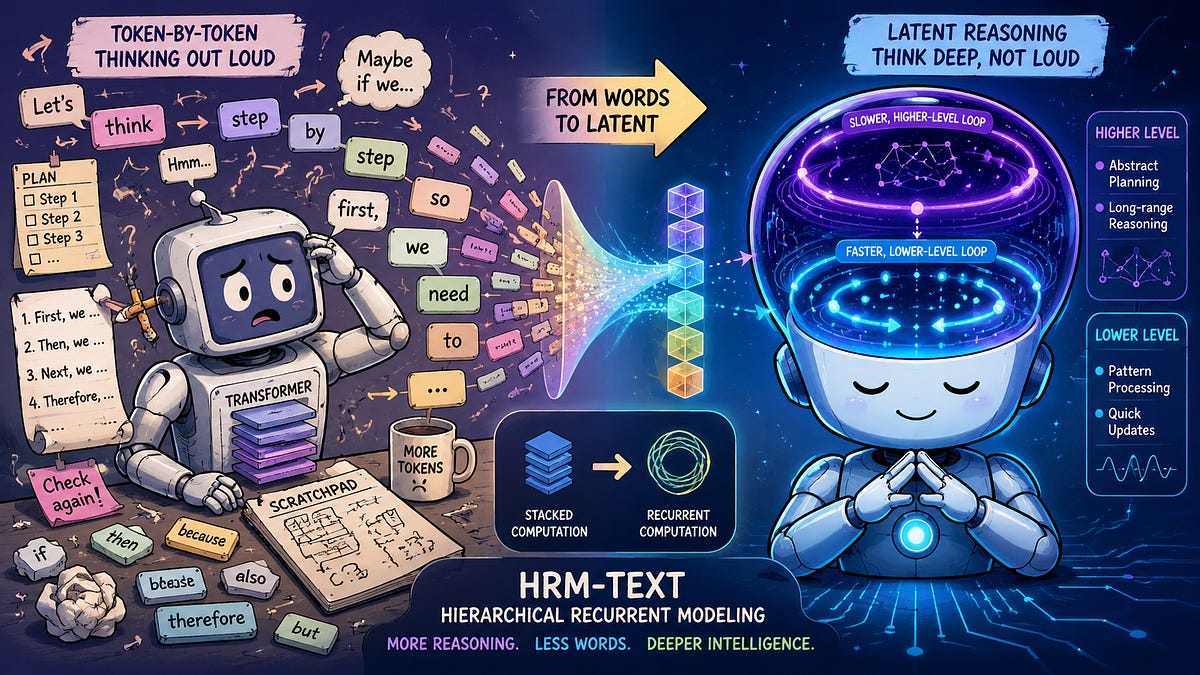
The prevailing wisdom is that standard Transformer models, for all their impressive capabilities, are inherently shallow. Think of them like a skyscraper with a fixed number of floors – no matter how tall you build it, it can only perform a certain depth of computation in one pass. The industry’s grand solution? Chain-of-Thought (CoT) prompting. This is where we ask the AI to ‘think out loud,’ to lay out its steps like a student showing their work on a math problem.
But here’s the kicker: CoT isn’t true reasoning. It’s more like a desperate hack, an AI having to translate its internal, high-dimensional thoughts into human-readable tokens, then back again for the next computational step. Imagine a supercomputer forced to write every intermediate calculation onto a sticky note, then read that note to perform the next operation. Absurd, right? It’s like trying to conduct a symphony by shouting instructions across a football field – noisy, inefficient, and prone to misinterpretation.
Sapient Intelligence, with its Hierarchical Reasoning Model (HRM) and now HRM-Text, is boldly saying, ‘We can do better.’ Their approach bypasses the token-stream charade altogether. Instead of making the AI spill its guts in English, they’re focusing on enabling reasoning within the model’s latent space – the internal, abstract representation of data where the real magic of neural networks happens. This is reasoning that’s fluid, dynamic, and, crucially, internal.
The ‘Thinking Out Loud’ Illusion
CoT, while undeniably useful for getting more predictable outputs from LLMs, feels increasingly like a crutch. It’s a way to fake depth by relying on the model’s ability to generate coherent sequences of text that mimic a thought process. But it’s a fundamentally sequential, and therefore slow and inefficient, way to tackle problems that require genuine, deep computational steps. The output tokens become a low-bandwidth communication channel for internal state transitions, a bottleneck in the pursuit of intelligence.
It’s like giving a brilliant composer a limited vocabulary of only ten words and expecting them to write a symphony. They can arrange those ten words in many ways, but the richness and nuance of a full orchestra are lost in translation. The Transformer architecture, in its standard form, has this limitation. It can stack layers, but each pass is still a relatively shallow computation.
Unlocking Latent Potential
Sapient’s HRM-Text, however, is a different beast. It’s not about bigger models or more CoT data. It’s about architectural innovation. By allowing computations to happen within the latent space, the model gains the equivalent of variable, internal depth. Think of it like giving that skyscraper the ability to rearrange its internal structure on the fly, creating deeper, more complex pathways for information to flow as needed. It’s a fundamental re-imagining of how an AI can process information, moving from a fixed-depth pipeline to a dynamic, internal computational engine.
This is where the ‘quiet rebuke’ to Chain-of-Thought lies. Sapient isn’t saying CoT is useless; they’re saying it’s a workaround for an architectural deficiency that can be addressed more directly. Their work suggests that true reasoning might be less about articulation and more about internal manipulation of abstract representations – a concept that resonates with how we understand human cognition itself, where much of our thinking is subconscious and non-verbal.
What Does This Mean for the Future?
If Sapient’s approach proves widely applicable and scalable, it could fundamentally alter the landscape of LLM development. We might see models that are not only more efficient but also capable of tackling problems currently out of reach for even the largest CoT-tuned models. This isn’t just about incremental improvements; it’s about a potential platform shift, akin to moving from basic arithmetic to calculus. It suggests a future where AI’s reasoning isn’t a performance for us to watch, but an intrinsic, internal capability.
Sapient Intelligence’s bet… is that this is fixable. Not by making the model bigger, not by training on more CoT traces, but by giving the architecture the one thing it doesn’t have: variable, internal, depth.
This is the sort of bold architectural bet that defines true progress in AI research. While the full implications and widespread adoption remain to be seen, HRM-Text is a powerful signal that the ‘thinking out loud’ paradigm might be reaching its limits, and that deeper, more profound forms of AI reasoning are on the horizon, brewing within the latent spaces. The future of AI reasoning might be less about eloquent explanations and more about elegant internal mechanics.
Here’s the thing: we’ve been so focused on making AI explain itself that we may have overlooked the possibility of making it think itself more effectively, directly. Sapient is planting a flag in that less-traveled territory, and the view from there looks incredibly promising.
Is Sapient’s HRM-Text a True Leap Forward?
It’s too early to declare a definitive victory, but HRM-Text represents a compelling and theoretically sound alternative to the current reliance on Chain-of-Thought. The model has demonstrated strong performance on benchmarks that typically require complex reasoning, suggesting that internal, latent-space computation can indeed yield strong results. The key will be scalability and generalizability – can this approach handle an even wider array of complex tasks, and can it be implemented efficiently across different model sizes and domains? The initial results are incredibly encouraging, hinting at a future where AI’s ‘thinking’ is less a performance and more a pure, internal process.
Why Does Latent Space Reasoning Matter for Developers?
For developers, a shift towards latent-space reasoning could mean more efficient models that require less computational overhead for complex tasks. Imagine AI tools that can solve complex problems with a fraction of the processing power currently needed. This could lead to the deployment of more sophisticated AI capabilities on edge devices, in real-time applications, and in scenarios where cost and energy consumption are critical factors. It also opens up new avenues for fine-tuning and controlling AI behavior by interacting with its internal representations, rather than just its output tokens.
🧬 Related Insights
- Read more: Gold Buries Treasuries as Reserve King
- Read more: ConfDroid’s SELinux Puppet Module: Finally Taming the Beast?
Frequently Asked Questions
What is Chain-of-Thought prompting? Chain-of-Thought prompting involves instructing an AI model to break down a complex problem into intermediate steps, essentially ‘thinking out loud’ before providing a final answer. This is often done by providing examples of step-by-step reasoning in the prompt.
How does Sapient’s HRM-Text differ from Chain-of-Thought? HRM-Text aims to perform reasoning internally within the model’s latent space, rather than generating explicit reasoning steps as output tokens. This approach bypasses the inefficiencies of tokenization and de-tokenization, potentially leading to more direct and powerful reasoning capabilities.
Will this make AI models smaller or faster? The goal of latent-space reasoning is to improve the efficiency and depth of computation for complex tasks. While it might not directly lead to smaller models, it could allow existing or moderately sized models to perform tasks that previously required much larger or more computationally intensive methods, thereby making them effectively faster and more capable for those tasks.