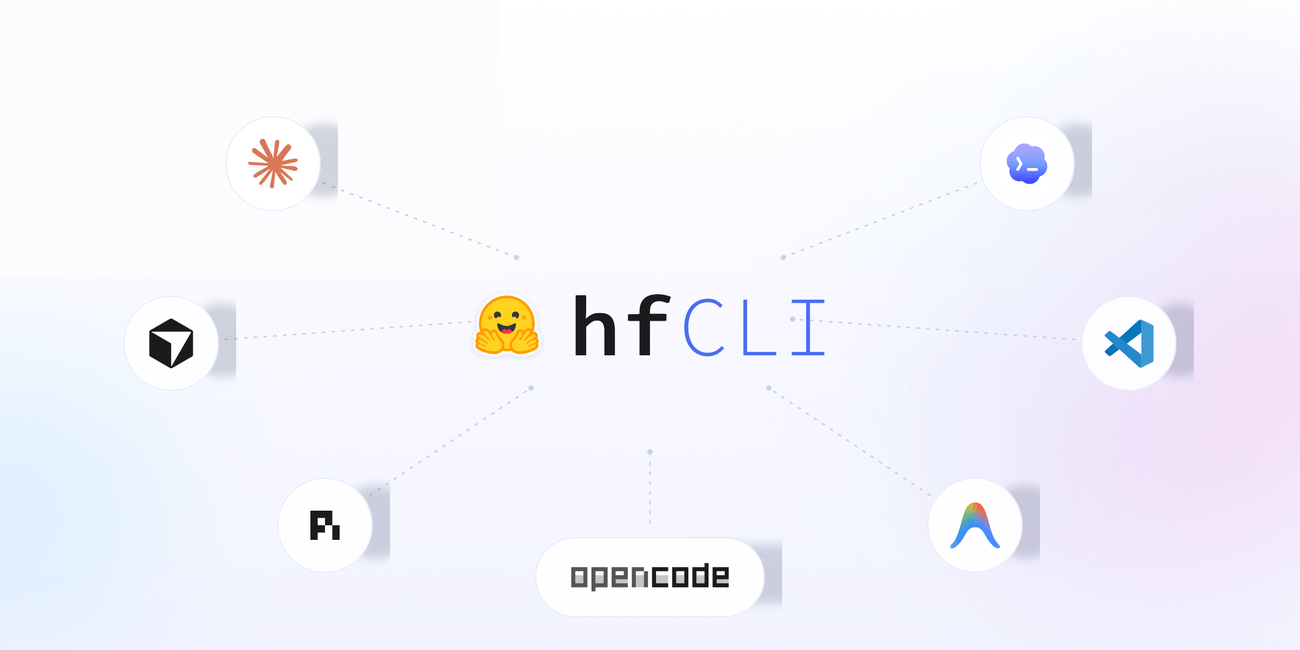
Everyone expected Hugging Face’s command-line interface, the hf CLI, to just keep getting better for us humans. More features. Slicker output. You know the drill. But here’s the thing: the real game-changer isn’t another pretty progress bar for your terminal. It’s for the AI. And it’s already saving them a fortune in tokens.
This isn’t some minor tweak. Hugging Face’s hf CLI, the gatekeeper to their entire Hub for models, datasets, and Spaces, has been fundamentally re-engineered. Why? Because the bots are coming. And they’re not playing by our rules.
Bots Don’t Need Pretty.
For years, developers have been polishing this tool for human eyes. Think ANSI colors, perfectly padded tables that vanish off-screen, little green checkmarks. All good stuff. Makes the terminal feel… alive. But for a coding agent like Claude Code or Codex, this is just noise. Visual clutter. Wasted bandwidth. Agents don’t need charm; they need data, raw and unadulterated.
What does this mean? It means the same command, run by a human versus an AI, now produces vastly different results. For us, it’s that nicely formatted table, maybe a bit cut off, with a helpful hint to see more. For an agent? It’s a dense, machine-readable data dump. No frills. Every single bit of information, delivered efficiently.
A human wants rich terminal output: ANSI color, padded tables truncated to fit the screen, a green ✅ on success,
✔for booleans, progress bars, prose hints. An agent wants the inverse: no ANSI, nothing truncated, every value in full since an agent can handle far denser output than a human, kept compact and structured to stay light on tokens.
This isn’t just about aesthetics; it’s about economics. The Hugging Face team claims that on complex, multi-step tasks, this agent-optimized CLI can use up to 6 times fewer tokens than a baseline approach where an agent has to cobble together curl commands or wrestle with the Python SDK. Six. Times. That’s a massive reduction in computational cost and, consequently, faster, cheaper AI operations.
Who’s Driving the Bus Now?
The shift isn’t theoretical. Hugging Face started tracking agent usage in April 2026, and the numbers are already significant. Agents like Claude Code and Codex are not just dabbling; they’re becoming major users of the Hub. Claude Code alone accounts for around 40,000 distinct users and nearly 49 million requests. Codex is right behind it. This isn’t a fringe use case anymore; it’s becoming a standard way for AI systems to interact with AI resources.
The CLI’s ability to auto-detect agent usage via environment variables like CLAUDECODE or AI_AGENT is key. It’s a silent handshake, a negotiation of output format without human intervention. This clever detection mechanism allows the hf CLI to serve two masters simultaneously, adapting its output on the fly.
The Ghost in the Machine Learning Machine
This begs a larger question: are we building tools for ourselves, or are we increasingly building them for the machines that will eventually build tools for us? The hf CLI’s transformation is a stark reminder that the interface paradigm is rapidly shifting. What’s considered “good UX” for a human might be an impediment for an AI.
This move mirrors earlier shifts in software development where specialized tools emerged for scripting and automation. We moved from manually typing commands to writing shell scripts, then to complex orchestration tools. Now, the orchestrators themselves are AI agents, and they need interfaces built for their unique cognitive architecture. Hugging Face is simply ahead of the curve in recognizing this.
What Does This Mean for the Future?
Expect more tools to follow suit. Anything with a significant AI user base will need to consider agent-native interfaces. This means prioritizing structured, machine-readable output over human-friendly flourishes. It means thinking about token efficiency as a primary design constraint. It might also mean that features we humans take for granted—like interactive prompts—will be rethought, or even removed, in agent-facing modes.
For developers using AI agents for tasks like model fine-tuning, dataset preparation, or deploying applications, this is unequivocally good news. It means your AI assistants will be able to work with the Hugging Face Hub more efficiently, leading to faster iteration cycles and lower costs. For Hugging Face, it solidifies their position as a central infrastructure provider for the AI ecosystem, catering to both human creators and their increasingly capable AI collaborators.
It’s a fascinating, perhaps slightly unsettling, glimpse into a future where our most powerful tools are optimized not for our own convenience, but for the machines that are rapidly learning to wield them better than we can.
🧬 Related Insights
- Read more:
- Read more: Anthropic’s Claude Mythos: The AI Exploit Machine Locked Away from You
Frequently Asked Questions
What does the hf CLI do?
The hf CLI is the command-line tool for interacting with the Hugging Face Hub. It allows users to download and upload models, datasets, and Spaces, manage repositories, and run jobs directly from the terminal.
Why was the hf CLI redesigned?
The CLI was redesigned to better serve the needs of AI coding agents, which are increasingly using the Hugging Face Hub. The new design optimizes output for machine readability and token efficiency, drastically reducing computational costs for agents.
How much more efficient is the new hf CLI for agents?
On complex, multi-step tasks, the agent-optimized hf CLI uses up to 6 times fewer tokens compared to agents using baseline methods like curl or the Python SDK.