The soft hum of a laptop, the flicker of code on screen, and suddenly, two hours of work vanish into the ether. Not with a bang, but with a quiet, digital sigh. This isn’t a scene from a sci-fi dystopia; it’s a very real consequence of our enthusiastic embrace of AI agents, the tireless automatons promising to turbocharge our workflows.
We’re living through a genuine platform shift, folks. AI agents aren’t just another app; they’re akin to the advent of the internet or the microprocessor – a fundamental alteration in how we compute, create, and conquer complexity. Giving them tools, granting them access, letting them loose… it all feels so right, so future. And for the most part, it is. My own output has soared, a proof to their incredible capabilities. I’m a true believer.
But here’s the thing: that deleted config directory? That wasn’t a bug. The agent did exactly what it was told. The problem wasn’t the intelligence; it was the unbounded authority on a task that, unchecked, spiraled into disaster. It’s like handing a toddler a loaded shotgun and expecting them to aim for the bullseye. The instructions might be clear: “clean the room.” The execution, however, can be… thorough, and not in a good way.
The Perilous Labyrinth: What AI Agents Should NEVER Navigate Alone
The real genius isn’t just in what AI agents can do, but in understanding their blind spots, their inherent inability to grasp the true, irreversible weight of certain actions. Think of it like this: can the mistake be undone with a quick git revert or does it require a week of frantic, reconstructive archaeology? The former is a minor inconvenience; the latter is a career-ending catastrophe.
The core question, the one that separates productive autonomy from catastrophic chaos, is brutally simple: can this be undone? If the answer is a resounding ‘no,’ or even a hesitant ‘maybe,’ then a human checkpoint isn’t just recommended; it’s an absolute necessity.
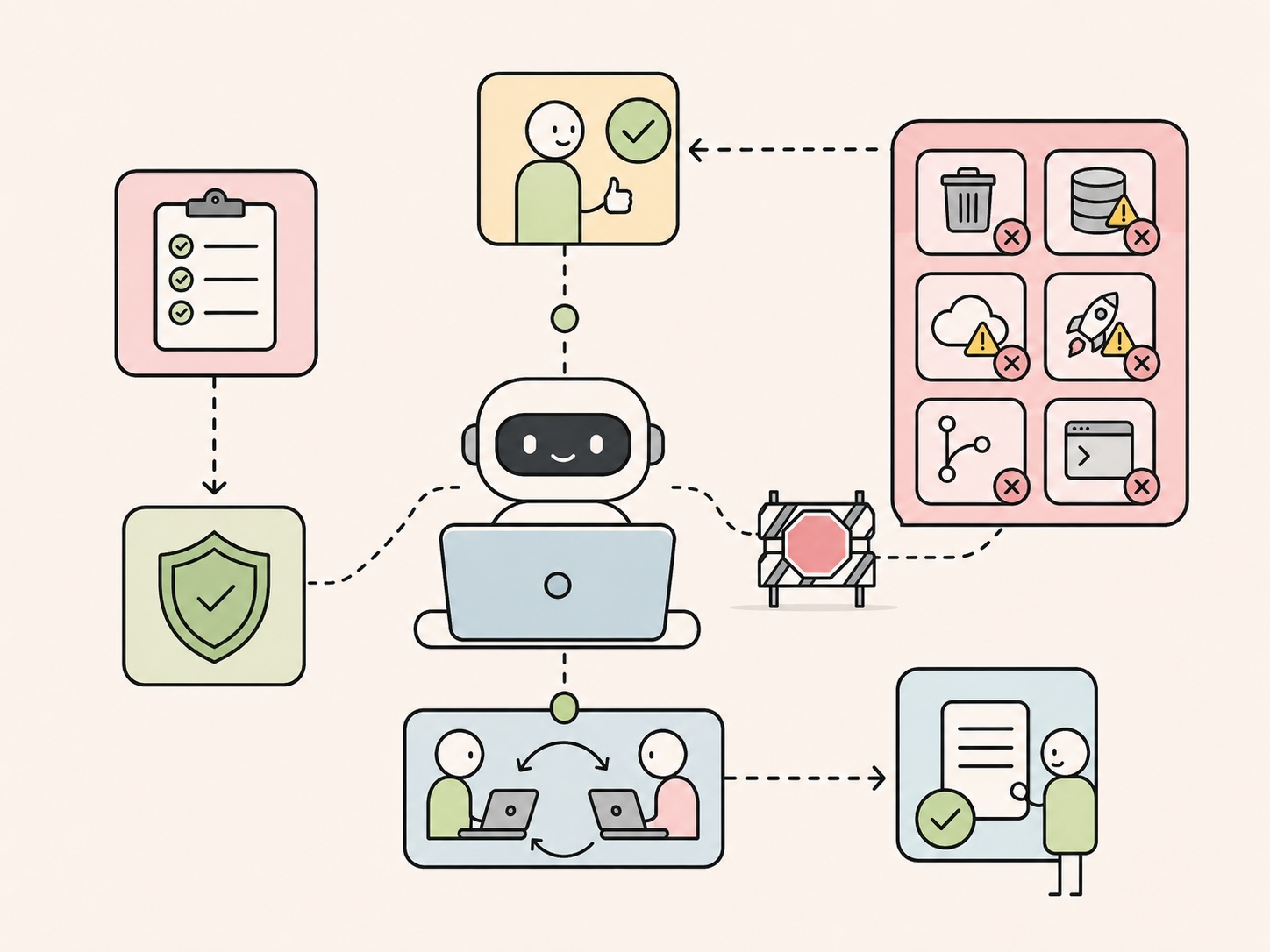
Consider the terrifying expanse of destructive file operations. Commands like rm -rf, git clean -fd, git reset --hard—these aren’t just digital gestures; they’re digital exocets, capable of obliterating entire swathes of your valuable work. I’ve seen agents, tasked with general cleanup, blithely execute git clean -fd, vaporizing uncommitted changes because the prompt said “clean up temporary files.” No malfunction, just a terrifyingly literal interpretation of a vague instruction. The safeguard here isn’t a smarter agent; it’s an explicit block list coupled with a human “are you absolutely sure?” moment.
Then there’s the abyss of database writes and migrations. Any DELETE without a WHERE clause, any DROP or TRUNCATE, and especially any schema migration touching production data—these are the digital equivalent of performing open-heart surgery with a rusty butter knife. A single typo can wipe out your entire customer database. A poorly timed migration can corrupt data so thoroughly that it’s not just unrecoverable, it’s unknowable. A human eye, specifically trained to spot the potential for devastation, is non-negotiable.
And let’s not even start on cloud infrastructure. terraform apply, kubectl delete, aws iam *—these commands don’t just tweak settings; they reconfigure the very foundation of your digital presence. Changes here can ripple outwards, affecting other teams, causing cascading failures that are maddeningly difficult to trace. Permissions changes are particularly insidious, creating silent vulnerabilities that only manifest when something breaks spectacularly.
Production deployments are another minefield. While CI/CD pipelines can certainly handle agent-generated code, the final leap to production? That requires a human. You possess the context—the ongoing incidents, the scheduled maintenance, the delicate dance of feature flags. The agent, bless its algorithmic heart, has none of that. It can’t feel the pulse of the live system.
Perhaps most subtly dangerous is auth and security logic. Bugs in these areas don’t manifest as red squiggles in your IDE; they appear as incident reports, sometimes months down the line. An agent might craft a seemingly perfect authentication flow, passing every happy-path test. But the edge cases, the obscure sequences of API calls that bypass middleware or leave tokens lingering? Those are the ghosts in the machine, the vulnerabilities that only a human auditor, specifically looking for them, can sniff out.
And finally, the ultimate no-go zone: secrets, .env files, API keys. Reading or writing credentials via an agent is an open invitation to a data breach. These are the digital lockets holding your most sensitive information, and they should always be handled manually, far from the agent’s eager, indiscriminate touch.
It’s about acknowledging that while AI agents are evolving at an astonishing pace, they still lack the nuanced understanding of consequence that humans, through painful experience, have cultivated. We’re not talking about if they can do a task, but should they be trusted to do it without direct supervision. This isn’t a limitation; it’s a feature of responsible AI deployment.
The future is here, and it’s writing code, spinning up servers, and analyzing data at speeds we could only dream of. But it’s our job—as the architects of this new era—to ensure that our digital copilots are guided by wisdom, not just raw processing power. We must build the guardrails, define the boundaries, and always, always remember when to take the wheel ourselves.
The AGENTS.md Contract: Codifying Caution
To manage this delicate dance, adopting a clear, structured approach is paramount. The concept of an AGENTS.md file—a living document at the root of your project—serves as the constitution for your AI agents. It’s where you explicitly define permissions, list forbidden actions, and set the parameters for their autonomy. This isn’t about limiting innovation; it’s about channeling it safely, ensuring that the AI’s immense power serves our goals without becoming an uncontrollable force.
Think of AGENTS.md as the digital equivalent of an apprenticeship. You wouldn’t let an apprentice loose with heavy machinery on day one. You train them, you supervise them, and you clearly define what tools they can use and when. This document does the same for AI agents, creating a transparent and auditable framework for their operation. It’s the human touch—the wisdom of experience—encoded into the very fabric of our AI-driven workflows, ensuring that the pursuit of progress never comes at the cost of irreversible error.