Bias in AI. It’s not a bug; it’s a feature, often inherited from the messy, imperfect data we feed our digital progeny. And for too long, auditing this inherent prejudice has been a shadowy, resource-intensive affair, particularly when dealing with sensitive or proprietary information.
But here’s the thing: the tools for exposing this rot are starting to mature. Take Mimesis, an open-source library that’s quietly carving out a niche for itself by enabling developers to generate synthetic, perfectly balanced datasets for rigorous model interrogation.
Auditing Model Bias with Mimesis
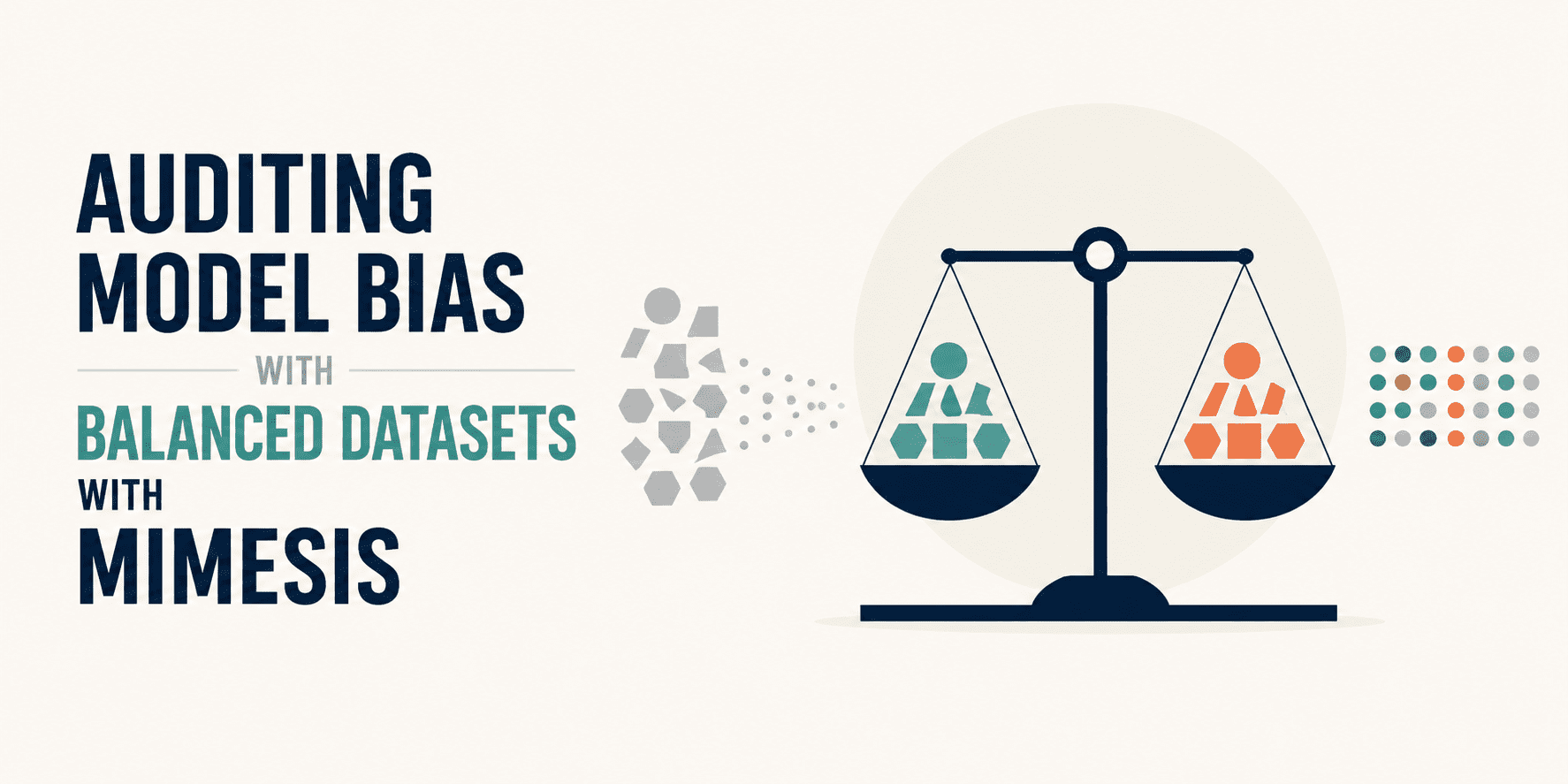
At its core, Mimesis is a synthetic data generation powerhouse. What makes it compelling for bias auditing, though, is its ability to construct counterfactual datasets. Think of it as creating a twin — two versions of the same entity, identical in every measurable way save for the specific attribute you’re testing for bias. This is precisely the kind of architectural finesse that moves us beyond hand-waving and into actionable verification.
Let’s walk through how this works. The challenge, as laid out in the accompanying guide, is to test a classification model that has been deliberately trained on biased historical data. We’re talking about a scenario where loan applications are approved based on gender in a way that subtly, or not so subtly, disadvantages women unless their income is stratospherically high. Standard procedure would involve trying to find or painstakingly curate more real-world data, a process fraught with privacy concerns and practical hurdles.
Instead, Mimesis lets us sidestep much of that mess. We first train a rudimentary decision tree classifier on our intentionally skewed dataset. It’s a simple setup: gender and income as features, loan approval as the outcome. The code itself is clean, a straightforward illustration of how easily historical inequities can be encoded into a model:
import pandas as pd
import numpy as np
from sklearn.tree import DecisionTreeClassifier
# 1. Simulating biased historical data (1000 instances)
np.random.seed(42)
n_train = 1000
genders = np.random.choice(['Male', 'Female'], n_train)
incomes = np.random.randint(30000, 120000, n_train)
approvals = []
for gender, income in zip(genders, incomes):
    if gender == 'Male':
        # Historically, males are approved
        approvals.append(1)
    else:
        # Only females with high income are approved
        approvals.append(1 if income > 80000 else 0)
train_df = pd.DataFrame({'Gender': genders, 'Income': incomes, 'Approved': approvals})
# Converting categories to numbers for the machine learning model
train_df['Gender_Code'] = train_df['Gender'].map({'Male': 1, 'Female': 0})
# 2. Training a Decision Tree classifier
model = DecisionTreeClassifier(max_depth=3)
model.fit(train_df[['Gender_Code', 'Income']], train_df['Approved'])
Now comes the Mimesis magic. The library’s Generic class is our conjurer here. We start by generating some foundational profiles, complete with unique IDs and a moderate income bracket. Notice the intentional omission of gender at this stage; it’s the variable we want to manipulate systematically.
from mimesis import Generic
generic = Generic('en')
# Generating 3 base financial profiles
base_profiles = []
for _ in range(3):
    profile = {
        'Applicant_ID': generic.cryptographic.uuid(),
        'Income': generic.random.randint(40000, 70000) # Moderate income
    }
    base_profiles.append(profile)
This yields profiles that are deliberately generic, setting the stage for our counterfactual experiments.
Why Does This Approach Matter for AI Ethics?
The real power emerges when we take these base profiles and create the crucial counterfactual pairs. For each original profile, we generate two records: one explicitly coded as ‘Male’ and the other as ‘Female’. Critically, every other attribute—the applicant ID, and most importantly, the income—remains identical. This isolates gender as the sole differentiator.
counterfactual_data = []
for profile in base_profiles:
    # Version A: Male Counterfactual
    counterfactual_data.append({
        'Applicant_ID': profile['Applicant_ID'],
        'Gender': 'Male',
        'Gender_Code': 1,
        'Income': profile['Income']
    })
    # Version B: Female Counterfactual
    counterfactual_data.append({
        'Applicant_ID': profile['Applicant_ID'],
        'Gender': 'Female',
        'Gender_Code': 0,
        'Income': profile['Income']
    })
audit_df = pd.DataFrame(counterfactual_data)
When we then pass this meticulously constructed audit_df through our previously trained model, any divergence in the predicted loan approval for male versus female counterparts, given the exact same income, becomes a clear signal of bias. This isn’t just about catching errors; it’s about understanding the mechanism of bias, revealing exactly where and how the model is making discriminatory judgments. The original article highlights this elegantly:
You’ll be able to test “fake” users with identical financial backgrounds but different demographic characteristics, thereby determining whether the model discriminates against certain groups or not.
This method represents a significant architectural shift in how we approach AI fairness. Instead of relying on noisy real-world data that might already be imbued with societal biases, we’re constructing controlled experiments. This is akin to a physicist setting up a vacuum chamber to isolate the effects of gravity, free from air resistance. Mimesis, in this context, provides the means to create that controlled environment for ethical AI auditing.
My unique insight here is recognizing that Mimesis isn’t just a data generation tool; it’s an experimental framework enabler. By abstracting away the complexities of creating diverse yet controlled synthetic data, it democratizes sophisticated bias auditing techniques. This allows smaller teams or organizations without massive datasets to rigorously test their models, potentially leveling the playing field and fostering more ethical AI development across the board. It’s a proactive, engineering-first approach to AI ethics, moving it from the realm of post-hoc analysis to pre-deployment validation.
How Does Mimesis Ensure Data Realism?
Mimesis use a vast array of providers, from geographical and professional data to personal details and even complex structures like addresses and phone numbers. For bias auditing, the key is its ability to generate specific, controlled variations. While the loan example uses simple Gender and Income fields, the library’s architecture supports generating far more complex, yet still controlled, data points that can be used to probe for subtler forms of bias across multiple dimensions simultaneously.
What Happens After Auditing?
Once bias is identified using Mimesis-generated counterfactuals, the next steps involve mitigation. This could mean retraining the model on a debiased dataset (which Mimesis can also help generate), adjusting model parameters, or implementing post-processing techniques to correct biased outputs. The crucial takeaway is that Mimesis provides the diagnostic clarity needed to even begin the remediation process effectively.
🧬 Related Insights
- Read more: Azure AI-102: Bootcamp Hype Meets Real-World Grind
- Read more: Why the Intel Arc B580 Crushes Local AI Dreams on a $249 Budget
Frequently Asked Questions
What does Mimesis actually do? Mimesis is an open-source Python library for generating synthetic data. It can create realistic-looking data for testing, development, and auditing purposes across various categories like personal information, locations, and more.
Will this replace real-world data for AI training? Not entirely. Mimesis is primarily for testing, auditing, and creating controlled datasets to probe specific behaviors or biases. While it can supplement training data, especially for edge cases or privacy-sensitive scenarios, real-world data often remains essential for capturing the full complexity of a problem.
Is auditing with Mimesis difficult to implement? No, Mimesis is designed to be user-friendly. The code examples show how straightforward it is to generate basic profiles and then create controlled variations, making it accessible for developers and data scientists looking to integrate bias auditing into their workflows.