OCR Meets Transformers. Finally.
PaddleOCR, a long-standing player in the optical character recognition (OCR) and document parsing space, has just dropped version 3.5, and it’s packing a significant architectural tweak: it’s now embracing Hugging Face Transformers as a first-class inference backend. This isn’t just another incremental update; it’s a strategic play to significantly lower the integration friction for developers already deep within the Hugging Face ecosystem. For those building complex document AI pipelines, RAG systems, or intelligent agents that chew through PDFs and scanned documents, this could be a much-needed simplification.
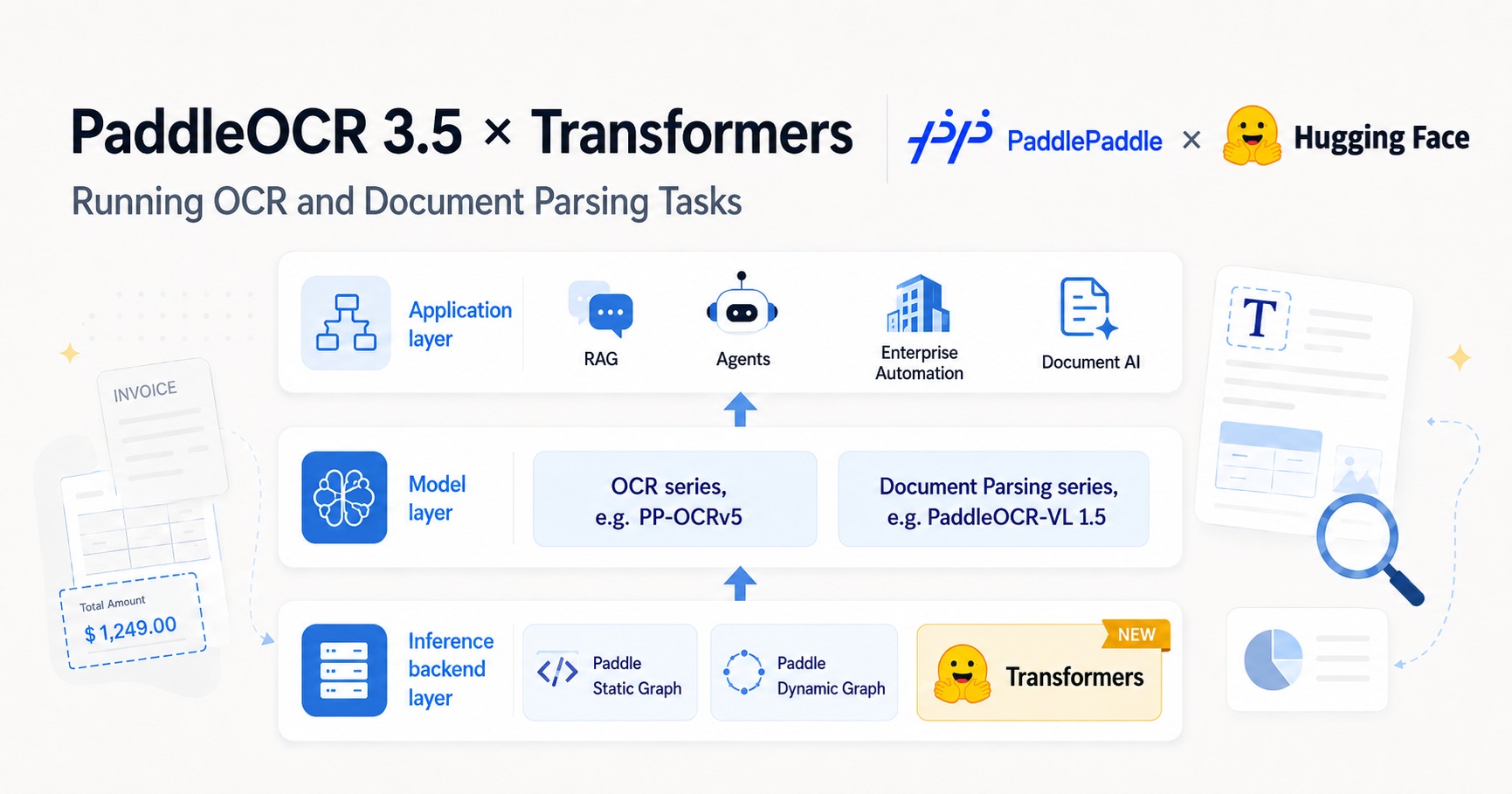
Historically, the journey from a raw document image to actionable data for an LLM has been, frankly, messy. The ingestion phase—turning everything from PDFs and screenshots to tables and charts into reliable structured data—is often the weakest link. A flawed ingestion pipeline means downstream LLM workflows can falter, missing critical context or returning nonsense. PaddleOCR, with its established model series like PP-OCRv5 and PaddleOCR-VL 1.5, has aimed to shore up this crucial first step.
Why Does This Matter for Developers?
Until now, integrating these powerful OCR capabilities into a Python-heavy, Transformers-centric stack meant wrestling with separate dependencies and sometimes convoluted data flows. PaddleOCR 3.5’s new engine="transformers" parameter fundamentally changes that. It allows supported PaddleOCR models to run directly within a Transformers backend, managed by PaddleOCR’s internal pipelines. This means developers can use their existing PyTorch and Transformers infrastructure for model loading, experimentation, and deployment—without having to contort their workflows.
Look, the market for reliable document ingestion is heating up. Companies are not just building LLM applications; they’re building end-to-end systems where the quality of the input data dictates the output. PaddleOCR’s move to offer a native Transformers integration is a direct response to this market demand, acknowledging that developer familiarity and ecosystem alignment are as important as raw accuracy for widespread adoption.
Developers first need to turn PDFs, scanned documents, screenshots, tables, charts, formulas, and complex page layouts into reliable structured data. If this ingestion step is weak, the downstream LLM workflow may miss key information, retrieve the wrong context, or produce unreliable answers.
Taming the Document Ingestion Beast
This integration is about more than just convenience; it’s about a smoother path from unstructured document chaos to structured data ready for advanced AI. For applications like Retrieval Augmented Generation (RAG), where accurate context retrieval is paramount, or for agents that need to accurately parse invoices or legal documents, the efficiency gains could be substantial. Imagine setting up a document processing pipeline that feels as natural as loading a BERT model—that’s the promise here.
While PaddleOCR’s default paddle_static backend remains the go-to for raw throughput maximization, the new Transformers backend is clearly aimed at a different segment: those prioritizing a familiar development experience and deep integration with the Hugging Face Hub. This includes easier model discovery and distribution for compatible PaddleOCR models, fitting neatly into existing MLOps practices.
The practical implications are clear: developers can now configure backend-specific options like dtype, device placement, and attention implementation directly through engine_config. This granular control, combined with the ease of selecting the backend via a simple engine parameter, should cut down on integration headaches significantly. The example code provided shows both command-line and Python API usage, demonstrating a commitment to developer accessibility.
Is This a Game Changer for Document AI?
Perhaps not “game-changing” in the sense of inventing entirely new capabilities, but certainly a significant step towards making powerful document AI more accessible. By aligning with the ubiquitous Hugging Face Transformers, PaddleOCR is betting on the developer community’s existing investment in that ecosystem. This is akin to a high-performance engine manufacturer suddenly offering a bolt-on kit that perfectly integrates with the most popular car chassis on the market. It’s about reducing friction and broadening the addressable market.
This move is particularly shrewd given the competitive landscape. Numerous companies are vying to provide the best tools for document understanding. PaddleOCR, by becoming more developer-friendly within a dominant framework, positions itself as a pragmatic choice for teams already committed to PyTorch and Transformers. It’s a move that prioritizes ease of adoption and ecosystem synergy over building yet another isolated OCR solution.
🧬 Related Insights
- Read more: QR Codes and Screenshots in 50ms: The API That Kills Puppeteer Nightmares
- Read more: Azure Kubernetes Service: Why Your Cost Optimization Strategy Is Probably Broken
Frequently Asked Questions
What does the Transformers backend do in PaddleOCR 3.5? It allows PaddleOCR to use Hugging Face’s Transformers library as the underlying inference engine for running its OCR and document parsing models, simplifying integration for developers already using Transformers.
Is this backend suitable for maximum performance?
For the absolute highest throughput, PaddleOCR’s default paddle_static backend is generally recommended. The Transformers backend prioritizes integration and developer experience within Hugging Face-centric stacks.
How do I install PaddleOCR 3.5 with the Transformers backend?
You’ll need to install PyTorch compatible with your hardware, followed by paddleocr==3.5.0, paddlex==3.5.2, and transformers>=5.4.0 using pip.