The meeting was already a disaster. You could feel the tension in the air thick enough to cut with a dull butter knife. Legal, armed with stacks of paper and a palpable sense of doom, was trying to explain nuance to IT, who stared back with the blank, unwavering gaze of a machine that only speaks in ones and zeros.
This is the frontline. The war of attrition between law and logic. For years, this was a manageable headache. A minor inconvenience. Now, with AI’s insatiable appetite for data, it’s an existential crisis. The old ways? Dead on arrival.
The Business-Minded Barrage
Business wants results. Period. Growth. Revenue. Optimization. They speak in KPIs, margins, and beating the competition. Compliance? It’s a speed bump. An obstacle to be navigated, not a sacred mission. They’re not malcontents; they’re just wired to chase the finish line. Analyze customer behavior? Test new features? Personalize experiences with AI? Extract more value from data? All music to their ears. The symphony of profit.
The Legal Labyrinth
Legal, on the other hand, lives in the murky world of acceptable risk. Zero risk? A fantasy. They need defensibility. Proof that they acted responsibly when challenged. Their language? Lawful basis, proportionality, mitigation, demonstrable intent. Legislation, written for humans, is a narrative. It’s deliberately principle-based, ripe for interpretation. Legal eagles are trained to dissect prose, not design database schemas or configure access controls. “Reasonable safeguards” doesn’t translate to code. “It depends” is IT’s death knell.
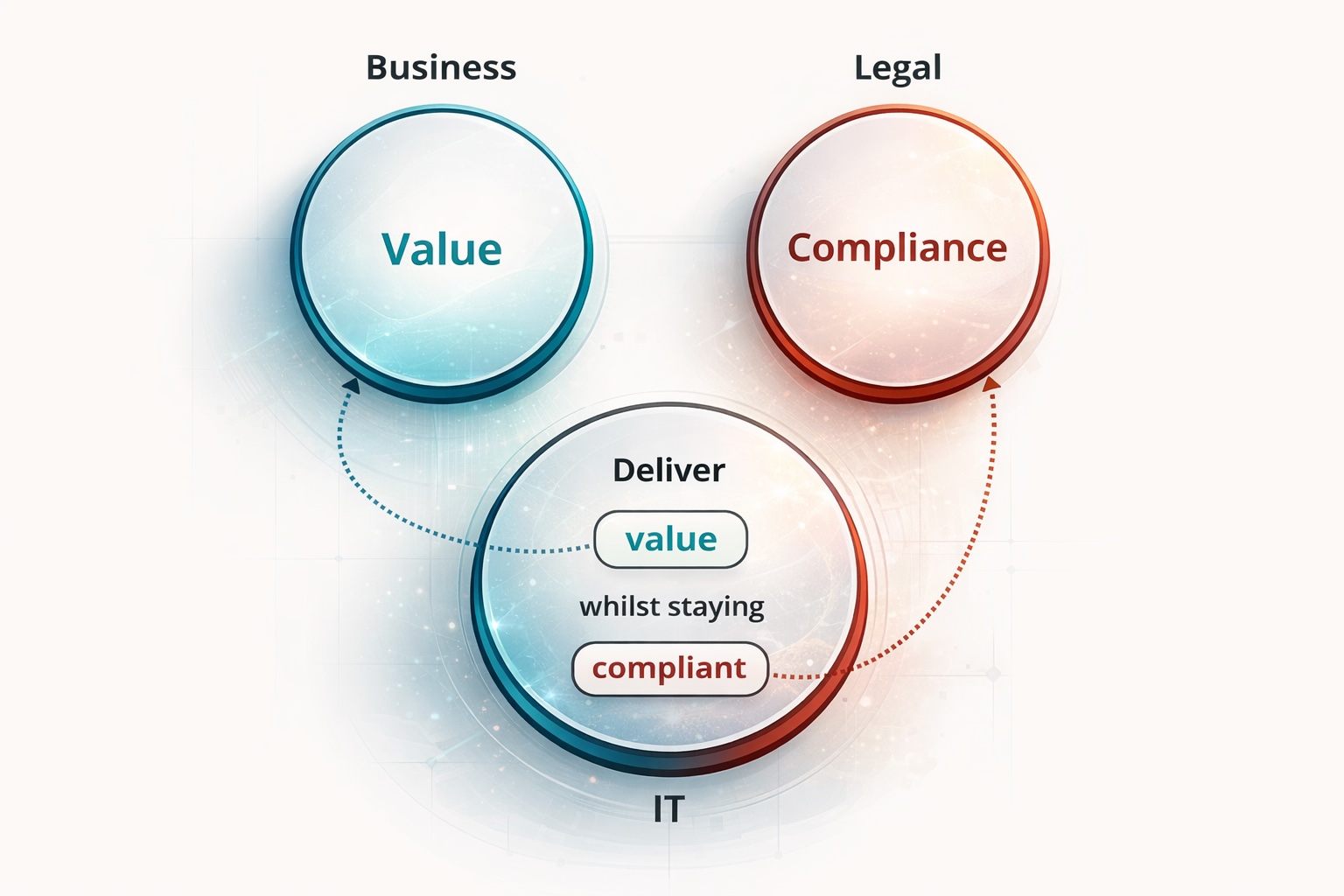
IT needs specificity. They need to know if a field is personal data. If a dataset can be used for training. Retention periods. Masking requirements. What, precisely, constitutes anonymization here? Business wants value. Legal wants compliance. IT is stuck in the middle, building systems that are supposed to do both. The result is a compliance burden that’s unevenly distributed and discussions that move at a glacial pace.
AI: The Great Exposer
This tension used to be manageable. Data usage moved slower. Manual oversight was feasible. Legal teams could review major initiatives. That era is over. AI’s volume and velocity of data usage are overwhelming traditional compliance models. Data isn’t linear anymore. It’s processed, combined, enriched, repurposed, and modelled ceaselessly. Autonomous agents can trigger workflows and make decisions without a human blinking an eye. At this scale, manual legal oversight simply breaks down. Legal can’t vet every new data use case. IT can’t interpret ambiguous clauses every time an engineer spins up a new pipeline. But business won’t slow innovation for interpretive debates.
Legal intent is rarely encoded in a way that systems can validate. Instead, compliance lives in PDFs, policies, meeting minutes and emails.
What’s missing is a shared interface. A structured, machine-readable form. Think metadata. Policy-as-code. Data contracts. These are the translation layers we desperately need. Instead of open-ended discussions, we need AI to validate usage automatically. Machine-readable governance. Legal defines boundaries. IT implements constraints. Business sees what’s permitted. We’re talking about moving from theoretical compliance to observable compliance.
From Legal Text to Architecture-Aware Controls
The solution isn’t more meetings. It’s a fundamental shift in how we operationalize legal intent. The proposal is straightforward: create a practical framework that translates legal directives into machine-readable and architecture-aware controls. This isn’t just about communication; it’s about building systems that inherently understand and enforce compliance. Imagine defining a data retention policy not in a PDF, but as code that directly interfaces with your data storage. Or specifying data anonymization requirements in a way that an AI model can verify before processing begins.
This framework would act as a bridge. For legal teams, it offers a way to articulate requirements with a level of specificity that IT can act upon. For IT, it provides clear, unambiguous instructions that can be directly implemented into system architecture and code. For business leaders, it brings transparency and predictability, showing them the guardrails within which innovation can safely occur.
This is a monumental task, requiring a deep understanding of both legal principles and technical implementation. But the alternative is a future where AI-driven innovation is perpetually stalled by legal roadblocks, or worse, progresses without adequate oversight, leading to massive risks. The gulf between law and logic is real, but AI, paradoxically, might be the only tool capable of bridging it.
🧬 Related Insights
- Read more: Sweden’s $137M Revolt: Ditching iPads for Pencils in Every Classroom
- Read more: Module Federation 2.0 Breaks Free From Webpack—And That Changes Everything
Frequently Asked Questions
What does this framework actually do?
It translates abstract legal requirements into concrete, machine-readable rules that IT systems can understand and enforce, enabling automated compliance validation for data usage and AI model development.
Will this replace lawyers or IT professionals?
No. It aims to equip them with better tools to collaborate, automating the tedious aspects of compliance translation so they can focus on higher-level strategy and risk assessment.
How soon can we expect this to be implemented?
The foundational concepts are emerging. Widespread adoption will depend on industry standards, tooling development, and a willingness from organizations to invest in integrating legal and IT workflows.