Did you ever stop to think how many clicks separate you from a finished product these days? AI was supposed to be the great un-complicator. Instead, we’ve built an entire industry on making simple tasks agonizingly complex. It’s the AI paradox, folks. And it’s costing us.
AI’s initial foray into the mainstream was, for many, a godsend. Suddenly, tasks that took hours melted away. Roles shifted. Efficiency soared. It was like discovering cheat codes for productivity.
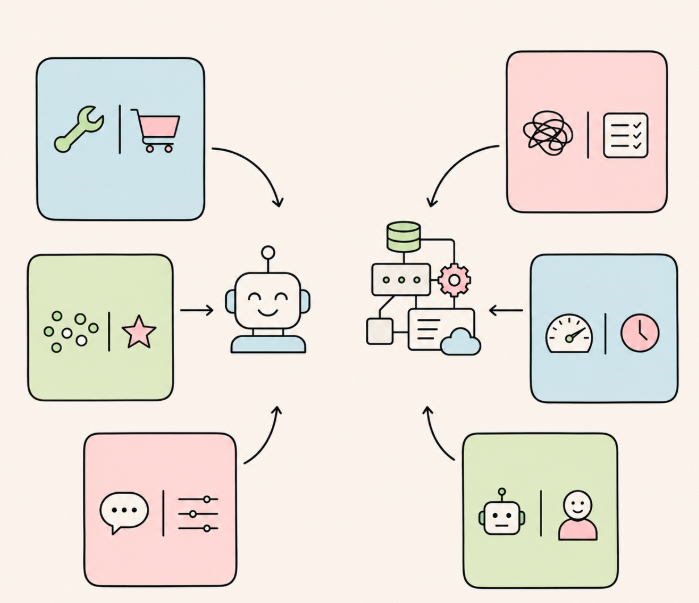
But then came the Cambrian explosion of AI apps. Now, instead of one tool, we’ve got ten. Each needs a specific prompt. Each demands its own context. Switching between them is like trying to assemble IKEA furniture with instructions in six different languages. You end up frustrated. And your output? Often a Frankenstein’s monster of disconnected ideas.
Consider the humble blog post. You draft with ChatGPT. Refine with Claude. Maybe tack on an image from Midjourney. Sounds good, right? Wrong. That’s hours of copying, pasting, re-prompting, and hoping the AI remembers what you told it five minutes ago. This isn’t simplification; it’s digital busywork.
This is the “AI paradox.” We’re not asking which AI is best anymore. We’re asking why AI is making our lives harder. It’s a valid question. And the answer isn’t the AI itself.
The Tyranny of Choice
On paper, having options seems great. More tools, more power. In reality? Decision fatigue. You spend as much time choosing the right tool as you do using it. Some studies suggest context switching can tank efficiency by 40%. With AI, where every prompt is a new puzzle, that number climbs. We’re not doing meaningful work; we’re managing a digital Swiss Army knife that’s perpetually jammed.
It’s Not the AI, It’s the Fragmentation
Blaming individual AI models is a red herring. Some are great at reasoning, others at creativity. The problem isn’t the AI’s inherent ability. It’s the fractured ecosystem. We’re forced to dance between specialized tools, constantly re-learning interfaces and re-explaining our needs. It’s exhausting.
The Unifying Principle: Workflow First
Forget the “which AI tool is best” debate. The real question is: “How do I make these tools work together?” This is where unified AI platforms come in. They’re not about replacing your favorite models. They’re about creating a cohesive layer that connects them. Think of it as the AI operating system you didn’t know you needed. Abacus AI is one example, built to orchestrate various AI functions.
The Power of Multi-Model Magic
No longer are you tethered to a single model’s strengths. A unified platform lets multiple AIs contribute to a single output. It’s a team sport, with each player bringing their best skill to the table.
Frictionless Flow
Outputs become inputs. No more endless copy-pasting. Each step feeds directly into the next, preserving context and sanity. The workflow becomes a smooth, unbroken line, not a series of disconnected hops.
Cognitive Offload
This shift is profound. Tool management? Gone. Prompt wrangling? Minimized. Suddenly, practitioners can focus on the actual work, not the digital plumbing. It’s about execution, not administration.
The Old Way vs. The New Way: A Blog Post Reimagined
Remember our blog post example? The old way involved drafting, then refining, then SEO tweaking, then image creation – four separate tool changes, four sets of re-prompts, maximum context loss.
With a unified platform, content and image generation, editing, and SEO all happen in one environment. Context is king. Duplication is banished. The result is a cleaner, faster, and far less maddening process.
Is this the end of specialized AI tools? No. But it’s the end of the chaos they’ve wrought when used in isolation. It’s time for AI to simplify, not complicate. And that requires a fundamental shift in how we integrate these powerful, yet often unruly, technologies.
How Does This Affect Developers?
For developers, the appeal of unified platforms lies in abstraction and efficiency. Instead of managing complex API integrations for dozens of disparate AI services, a single platform can offer a more consistent interface. This reduces boilerplate code, speeds up prototyping, and allows teams to focus on building core application logic rather than becoming AI integration specialists. It’s about making AI a more accessible and less volatile component within larger software systems.
🧬 Related Insights
- Read more: CrystalRAT: Malware That Flips Your Screen While Stealing Your Data
- Read more: TypeScript 6.0 Kills ES5, Ushers in Temporal — NgRx Signals Get Smarter for Forms
Frequently Asked Questions
What is the “AI paradox”? It’s the frustrating reality where AI tools, designed to simplify tasks, actually complicate workflows due to fragmentation and the need to switch between multiple interfaces.
Will unified AI platforms replace individual AI tools? No, they aim to integrate and orchestrate existing specialized AI tools, allowing users to use their combined strengths within a single workflow.
How much time can be saved with a unified AI approach? While exact figures vary, significant time savings are expected by reducing context switching, repetitive prompting, and manual effort in combining outputs from different AI systems.