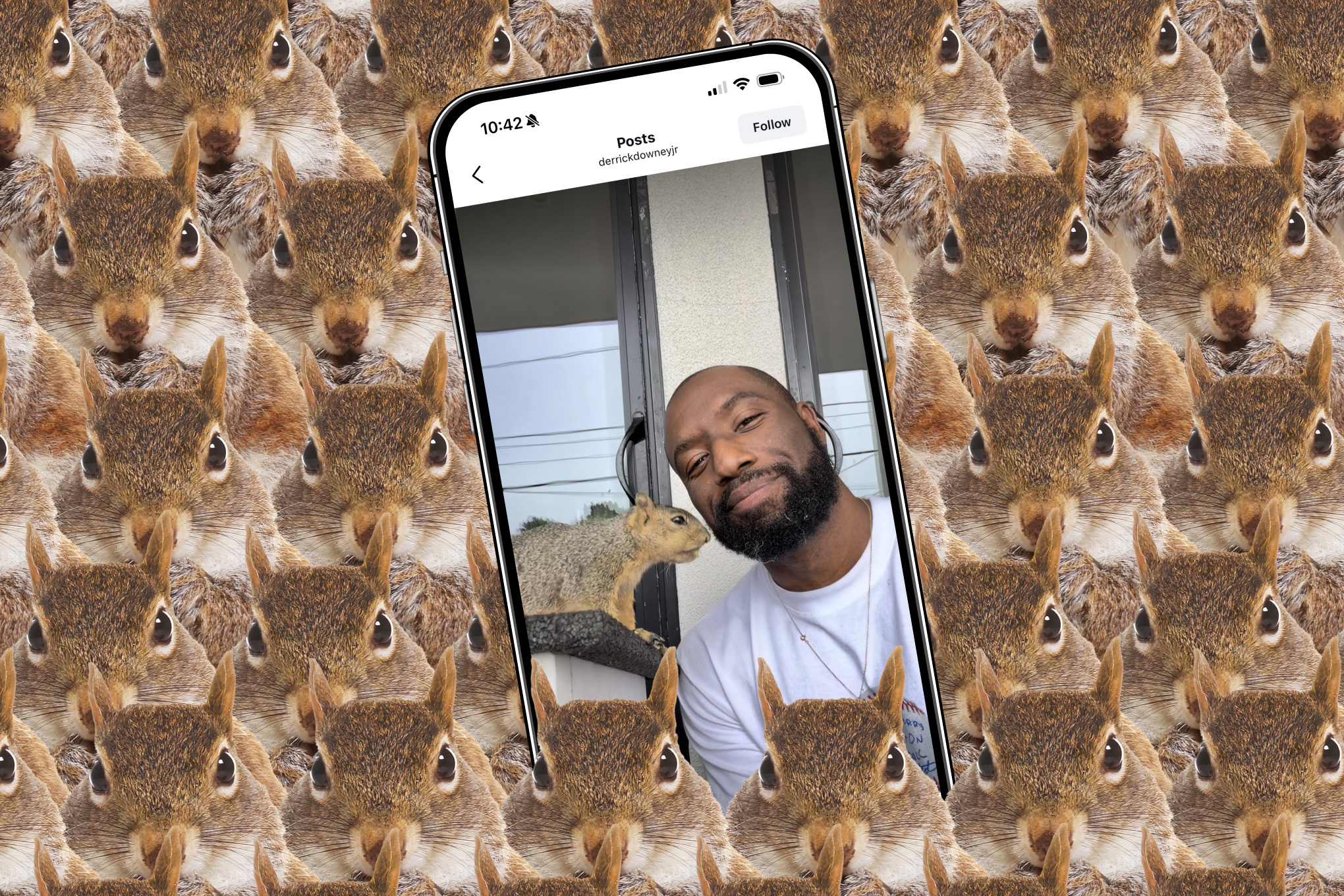
Twelve hours. That’s all it took for DualShot Recorder, an app born from a love of squirrels and a healthy dose of AI-assisted tinkering, to hit number one on the App Store’s paid charts. Let that sink in. No venture capital rounds, no legions of engineers burning through Series B funding. Just Derrick Downey Jr., better known to his millions of followers as the internet’s favorite squirrel dad.
Here’s the thing about Silicon Valley: it thrives on hype, on the manufactured narrative of disruption. We’re fed stories of coder prodigies in garages, of brilliant minds solving humanity’s biggest problems. But sometimes, the biggest disruptions come from the most unexpected places. Downey, whose Instagram and TikTok accounts are a masterclass in wholesome content featuring his bushy-tailed patrons (Maxine, Richard, and the infamous Hoodrat Raymond), wasn’t looking to conquer the tech world. He just wanted a better way to film his furry friends.
The Dual-Camera Conundrum
Downey’s dilemma was a common one for content creators: how to capture both vertical and horizontal footage simultaneously without a ridiculous amount of post-production hassle or expensive, clunky rigs. Cropping in post, he points out, is a resolution killer on modern phones, essentially making you shoot with a tiny peephole of the sensor. His initial attempts to cobble together solutions with existing tech proved, in his words, “too taxing.”
Then came the AI.
Initially, Downey experimented with ChatGPT, attempting to ‘vibe-code’ a solution into existence. It sputtered. He set it aside. But a nagging feeling, that familiar spark of an idea, brought him back. This time, armed with a deeper dive into Apple’s camera API and a renewed push with AI tools, something clicked. He found that Apple’s camera API offers third-party developers access to the full sensor readout – a capability often underutilized. His vision: use this to capture both aspect ratios directly, in-camera, without sacrificing quality. After a few months of what he calls “prompt engineering” – a term that still makes me twitch – he had a working prototype.
It’s fascinating, really. The genesis of a product that can out-perform established players isn’t some abstract algorithmic breakthrough; it’s the practical need of a guy who wants to film squirrels. And the tool that made it happen? Not a team of PhDs, but a language model.
“You would think that because you’re giving the prompts to this machine that it would give you accurate data. But I found that not to be the case, so I would then have to correct it.”
This quote, from Downey himself, perfectly encapsulates the current state of AI development for non-programmers. It’s not magic. It’s a tool that requires a discerning user, someone who understands the desired outcome and can iterate, correct, and guide the AI toward that goal. Downey’s self-awareness about the AI’s inaccuracies, and his meticulous process of double-checking and triple-auditing its outputs, is precisely why this app works. He wasn’t just passively feeding prompts; he was actively building with the AI, treating it like an incredibly complex, often stubborn, but ultimately capable assistant.
The ‘Vibe-Code’ to the Top
So, he put the app, priced at a reasonable $6.99 (now $9.99, still no subscription, and blessedly, no user data collection), on the App Store. The results? Astounding. Eight days at number one. Still clinging to the top 20. The appeal is clear: a simple, effective solution to a real problem, with no privacy invasions. Downey prioritizes user privacy, a stance that, ironically, makes bug-fixing harder – less data means less insight into what’s going wrong. He’s already working on a troubleshooting feature for this.
This whole episode is a stark reminder that innovation doesn’t always come from the established hubs of technological power. It comes from necessity, from creativity, and now, increasingly, from the surprising power of accessible AI tools wielded by individuals. The question now isn’t if AI can create tools for creators, but who will be the next Derrick Downey Jr. to discover it? And more importantly, who is actually cashing in? For now, it seems like the squirrel dad is doing alright.
Who is Actually Making Money Here?
Right now, it’s Derrick Downey Jr. and Apple, through App Store commissions. There’s no subscription model, no in-app purchases, no user data being sold. It’s a clean, direct transaction. This is refreshing and, frankly, unusual in the current app landscape. The success of DualShot Recorder suggests a market for well-designed, one-time purchase utilities that solve specific problems without nickel-and-diming users or prying into their privacy. The app’s primary monetization is through the sale of the app itself.
The AI Angle: Hype vs. Reality
This story is a masterclass in separating AI hype from AI utility. Downey didn’t use AI to dream up the app; he used it to build it. He recognized a functional need, explored existing technical capabilities, and then employed AI as a sophisticated tool to bridge the gap. His ability to guide and correct the AI, rather than relying on it blindly, is the key. This isn’t about AI replacing human ingenuity; it’s about AI augmenting it. The “vibe-coding” is really just skilled prompt engineering and a deep understanding of the desired outcome. It’s a proof to what an individual can achieve when they have a clear vision and the right tools at their disposal, even if those tools are still in their nascent stages.
Is This Just a Fluke?
Calling it a fluke would be dismissive. While Downey’s viral fame certainly provided a massive initial boost, the app’s sustained performance suggests it’s filling a genuine need. The fact that it’s a clean, functional utility with a clear value proposition – dual-angle recording without quality loss – is its strongest asset. The AI aspect is the how, not the why. The why is solving a real creator problem. If other apps can offer similar functionality with a comparable or better user experience, they might emerge. But for now, Downey has a solid product that resonated with a large audience.
Why Does This Matter for Developers?
For professional developers, this is a wake-up call. It highlights the power of accessible AI tools, not as replacements, but as accelerators. It also underscores the importance of practical problem-solving. Downey identified a specific pain point and built a targeted solution. While many developers focus on broad platforms or complex systems, this demonstrates that a niche, well-executed app can achieve significant success. It also shows that if you understand the underlying APIs and can guide AI effectively, you don’t necessarily need a decade of traditional coding experience to build something valuable. The barrier to entry for creating is lowering, but the barrier to quality and user-centric design remains high – and Downey met that bar.
🧬 Related Insights
- Read more: JavaScript Primitives vs Non-Primitives: Atoms and Galaxies of Code
- Read more: Veridian Guard: One Decorator to Rule Flaky LLM Calls
Frequently Asked Questions
What does DualShot Recorder actually do? DualShot Recorder allows users to record both horizontal and vertical video footage simultaneously from their iPhone’s camera sensor without losing resolution. It use Apple’s camera API to capture full sensor data and crop it in-camera.
Will this app replace my need for two cameras? For many content creators, especially those on mobile, it can eliminate the need for a second device or extensive post-production work to achieve dual-angle footage. It’s a convenient solution for capturing both orientations at once.
Is DualShot Recorder using AI to film? While the app was built using AI tools like Claude for prompt engineering and code generation, the final app itself is a functional camera utility. It doesn’t use AI to alter footage in real-time or make creative decisions; it executes a specific technical function.