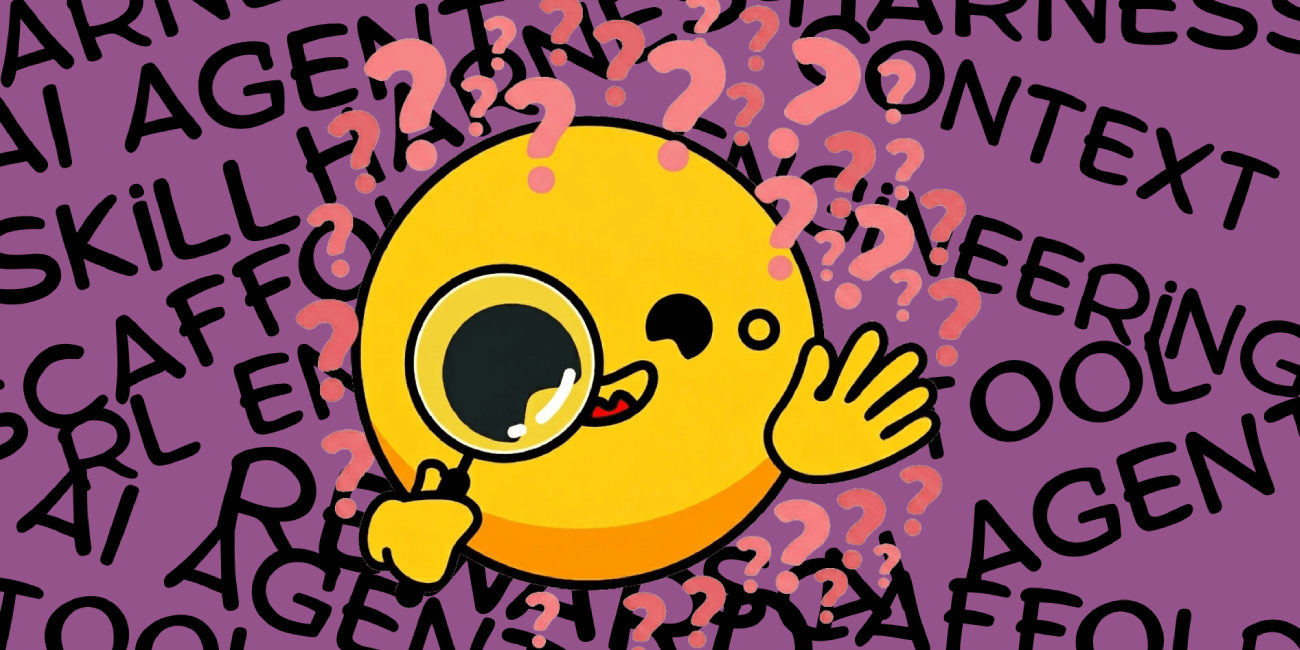
The air in the convention hall buzzed, a tangible hum of innovation and a thousand whispered conversations about AI. Amidst it all, a single question, posed by a perplexed attendee, echoed a sentiment shared by many: “What do you mean by the terms ‘harness’ and ‘scaffold’ in the context of agents? I have heard a lot of explanations while I was at ICLR, but I could not understand why they did not converge to a single explanation.”
This, right here, is the crucible of our current AI moment. It’s a platform shift, an explosion of capability, and with that comes a torrent of new language. Terms like ‘harness’ and ‘scaffold,’ while seemingly technical, are actually the foundational bricks of this new digital architecture. They aren’t just buzzwords; they’re essential concepts for anyone trying to understand, build, or even just use the next generation of intelligent systems. And frankly, the confusion is understandable.
This isn’t about memorizing a dry dictionary. It’s about building mental models, those intuitive frameworks that let us see the forest for the trees. Think of the early internet – remember ‘hyperlink’? It meant something specific, a digital pointer, and understanding it was key to navigating the nascent web. These AI terms are that, but for a far more profound technological leap.
The Core Ingredients: Model, Scaffold, and Harness
At the heart of every AI agent is the model – the LLM itself. It’s the brain, the sophisticated engine that takes text in and spits text out. Think of it as an incredibly powerful, but solitary, oracle. It can answer your prompt, but then it’s done. No memory, no iterative thinking, no external action on its own. To make this oracle do anything more, you need two crucial components: scaffolding and a harness.
Scaffolding is the environment, the carefully constructed world you build around the model. It’s the system prompt that whispers instructions in its ear, the detailed descriptions of tools it can access, the rules for how its responses are parsed, and crucially, how it remembers things from one step to the next. Scaffolding shapes the model’s perception of reality and dictates its potential actions. It’s the blueprint, the context, the entire setup that guides the LLM’s behavior, whether it’s learning or actively performing a task.
And then there’s the harness. This is the engine, the active executor. It’s the loop that calls the model, processes its requests to use tools, and determines when the job is done. The harness is what makes the agent run. If scaffolding is the instruction manual and the toolbox, the harness is the mechanic actually doing the work, driving the car, and deciding when the engine needs another tune-up. Products often blur these lines, with some—like Claude Code and Codex—tightly coupling their harnesses to specific models. Others, more flexibly, allow you to swap in different LLM brains.
When people talk about products like Claude Code, Codex, or Cursor, they’re referring to a specific harness built on top of a specific model, designed and optimized together. Two products using the same underlying model can feel completely different because their harnesses make different choices.
It’s this interplay, the subtle distinction between the static instructions (scaffolding) and the dynamic execution (harness), that often causes the most head-scratching. But understanding it is key to grasping how these agents aren’t just passive text generators, but active participants in complex workflows.
Agents: More Than Just a Model
So, what exactly is an agent? In the grand AI scheme, it’s the synergy of the model and its surrounding machinery. It’s Model + Harness – a simple equation that unlocks colossal potential. It transforms raw text output into a system capable of performing actions, iterating, and achieving goals. Imagine a coding agent. Its scaffolding might include instructions on how to interpret code snippets and descriptions of programming tools. The harness, however, is the relentless loop that feeds code to the model, interprets its proposed changes, calls tools to compile or test, and then decides whether more refinement is needed. This loop is the lifeblood of agentic behavior, a concept deeply rooted in reinforcement learning’s own action-response cycles.
This distinction is vital. Two agents might use the exact same LLM, the same ‘model,’ but if their scaffolding and harnesses are different, they will behave like entirely different entities. One might be a meticulous programmer, the other a creative coder, all because of how their ‘world’ is constructed and how their ‘actions’ are executed.
Why Does This Matter for the Rest of Us?
Because this isn’t just for the AI researchers locked away in labs. This is for us. We’re already interacting with agents through tools like Claude Code, Codex, and Hermes. As these systems mature, understanding these core concepts will empower us to use them more effectively, to diagnose when they’re not performing as expected, and even to contribute to their development.
This is akin to learning to drive. You don’t need to understand the combustion engine (the model) to operate a car (the agent). But knowing the difference between the steering wheel and the accelerator (scaffold and harness) helps you drive with purpose and control. And as we build more sophisticated applications, a deeper understanding of these components will be essential for architects and developers.
The Unseen Infrastructure: Beyond the Agent
While the terms ‘harness’ and ‘scaffold’ are most visible in the operational agent, the underlying infrastructure is equally fascinating—and often overlooked. Concepts like context engineering, the art of crafting and managing the information the model receives, are paramount. Then there’s policy, the overarching strategy dictating the agent’s behavior and decision-making. Tool use itself is a skill, a learned capability for the agent to use external functions. And the idea of sub-agents, agents designed to perform specific, smaller tasks, points to a future of distributed intelligence where complex problems are broken down and tackled by a swarm of specialized AI actors.
My unique insight here? We’re not just building smarter tools; we’re building distributed cognitive systems. The way we define and combine these components—the model, the scaffold, the harness—is fundamentally redefining what ‘computation’ even means. It’s moving beyond simple input-output to a continuous, adaptive cycle of perception, decision, and action. This is the essence of building a truly intelligent, platform-level technology. It’s a whole new operating system for reality.
🧬 Related Insights
- Read more: Coruna: The iOS Exploit Kit That Went From Spy Weapon to Scam Bait
- Read more: 22 Ironclad Checks to Lock Down Your MCP Servers
Frequently Asked Questions
What does ‘agent’ mean in AI? An AI agent is a system that combines a large language model (LLM) with surrounding components, called a harness and scaffolding, allowing it to perceive its environment, make decisions, and take actions iteratively to achieve goals.
How is ‘harness’ different from ‘scaffold’ for AI agents? The scaffold provides the instructions, tools, and memory context for the model, shaping its understanding and potential actions. The harness is the execution layer that runs the model, manages tool calls, and controls the iterative loop of the agent’s operation.
Will AI agents replace my job? AI agents are poised to automate many tasks, potentially changing the nature of many jobs. However, they are also creating new opportunities in AI development, management, and specialized roles. The impact will likely involve significant job evolution rather than outright replacement for many professions.