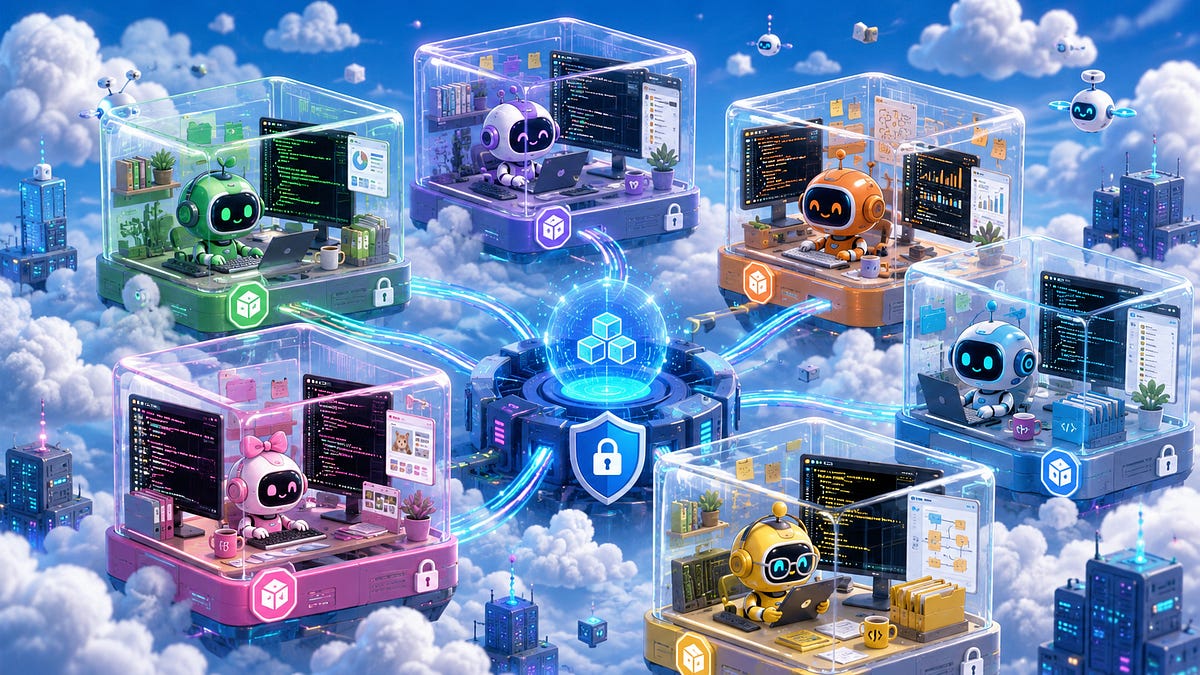
Did you ever stop to think about what an AI agent really needs to operate? It’s not just a fancy code execution box. It’s a whole damn computer.
And here’s the thing: while the LLM OS stack has become a standard toolkit, rapidly consolidating around familiar interfaces, the underlying infrastructure requirements for these AI agents are radically different. Products like Perplexity, Manus, and Cursor are all embracing this shift towards “Computers” for AI. Simultaneously, research benchmarks like TerminalBench and GDPVal are built on the assumption of an accessible computational environment—think Harbor. Daytona, a company that’s seen its fortunes rise on the back of this consolidating OS stack, is a key player in this burgeoning market.
Ivan Burazin, the force behind Daytona, has been fixated on this problem for years. His obsession? The “end of localhost.” Before the current agent craze, Burazin was already pushing the envelope with CodeAnywhere, one of the earliest browser-based IDEs. The dream was to decouple development from the fickle nature of local machines, to achieve reproducible setups and banish the dreaded “works on my machine” excuse to the dustbin of history. The market wasn’t quite ready then, but the underlying thesis was sound.
Agents changed the game. They’re indifferent to your souped-up MacBook Pro or your meticulously curated dotfiles. What they demand is API-accessible compute—something that’s stateful enough to persist, fast enough to spin up on a dime, flexible enough to scale on demand, isolated enough for security, and composable enough to handle the chaotic, real-world workflows that define actual software engineering. Daytona, in essence, is the latest manifestation of Burazin’s original “end of localhost” vision, but reimagined for the age of AI.
The Unseen Compute Needs of AI Agents
Daytona isn’t merely serving up code execution sandboxes. It’s providing the computational substrate for AI agents to thrive. The demands are staggering: composable computers, stateful environments that don’t disappear after a task, near-instant startup times, dynamic resource allocation, and infrastructure capable of handling a seismic shift from minimal usage to potentially hundreds of thousands of CPUs in mere moments. This isn’t just about running a script; it’s about powering autonomous agents with persistent, adaptable computational power.
Why Agents Demand More Than Just Sandboxes
Think about it. A code execution box is a one-off. You give it code, it runs, it spits out a result, and then it’s gone. An AI agent, on the other hand, might need to maintain context across multiple interactions, learn from past failures, and adapt its strategy. It’s less like a disposable tool and more like a digital employee. This requires a persistent, stateful environment—a true computer, albeit one accessed via API. Burazin’s pivot from human development environments to AI sandboxes reflects this fundamental realization. The MVP, rushed out on New Year’s Eve, wasn’t just an iteration; it was a desperate response to customer demand for this more strong computational paradigm.
Agents need a computer they can access through an API: something stateful enough to keep working, fast enough to spin up instantly, flexible enough to resize, isolated enough to be safe, and composable enough to run the messy real-world workflows that real software engineering actually requires.
Daytona’s architectural choices underscore this. Opting for bare metal, with its own custom scheduler rather than relying on the often-burdensome Kubernetes for this specific workload, signals a commitment to optimizing for speed and control. The reported startup times of around 60 milliseconds for a single sandbox, and an astonishing 75 seconds to spin up 50,000, speak to an infrastructure built for the kind of spiky, high-demand workloads characteristic of agentic AI tasks. One customer, running nearly 850,000 sandboxes daily, highlights the sheer scale of this emerging compute market.
The explosion of Reinforcement Learning (RL) and evaluation workloads is particularly telling. These tasks went from virtually zero to consuming roughly 50% of Daytona’s usage within months. This isn’t your typical web server or batch processing job; it’s computationally intensive, often unpredictable, and requires resources that can scale up and down aggressively. The comparison to managed Kubernetes services like EKS/GKS, and customer declarations of “never going back,” suggest a significant architectural mismatch between traditional cloud offerings and the demands of AI agents.
The Operating System Conundrum for Agents
Here’s a twist: agents might need not just Linux, but Windows and macOS machines too. This isn’t just about tooling compatibility; it’s about the complexity of the workflows agents are expected to handle. Apple’s licensing, a perennial thorn in the side of cloud providers, makes offering macOS environments tricky, but the demand is clearly there. And while the Graphical User Interface (GUI) might seem less relevant for an agent, Burazin suggests that the Command Line Interface (CLI) actually offers agents more power than a traditional Managed Compute Platform (MCP) could. It provides a direct, programmable interface for interaction and control.
Daytona’s embrace of open source further fuels its integration potential. By making agents more amenable to integrating with their platform, they’re tapping into a powerful network effect. However, this also raises questions about the future of CI/CD pipelines. Agent-generated pull requests, which might be more frequent and less predictable than human-generated ones, could fundamentally disrupt existing continuous integration and deployment workflows. We’re talking about a paradigm shift that requires rethinking the very definition of a code commit.
A New Model for the AI Cloud?
The implications extend to the business models of AI SaaS companies. Those reselling tokens in a straightforward manner might face a “cold shower” as compute demands and costs become more transparent and directly managed. Burazin’s analogy of the future AI cloud looking more like Stripe than AWS is particularly insightful. Stripe, with its API-first, developer-centric approach focused on providing a smoothly, embedded financial infrastructure, represents a model of abstraction and developer empowerment. It’s a stark contrast to the sprawling, complex, and often opaque nature of AWS. This suggests a future where AI infrastructure is not about managing vast arrays of generic compute, but about providing highly specialized, composable computational capabilities that developers and agents can easily integrate and use.
Daytona’s journey, from the early days of “end of localhost” to powering the complex needs of AI agents, illustrates a profound architectural shift. It’s a move from simply executing code to providing the very computers that will define the next generation of intelligent systems. The compute market for AI agents isn’t just growing; it’s fundamentally changing the rules of engagement for cloud infrastructure.
**
🧬 Related Insights
- Read more: Django Simple Deploy’s PythonAnywhere Fix: One Dev’s Quest to Save Noob Deployments
- Read more: Doctors Company Slaps ‘Interim’ on Claims Chief as 42-Year Vet Bails
Frequently Asked Questions**
What does Daytona actually do? Daytona provides composable computers for AI agents, offering stateful, scalable, and near-instantaneous compute environments designed for complex AI workflows, moving beyond simple code execution sandboxes.
Will this replace my job as a developer? Daytona and similar platforms aim to augment developer workflows and power AI agents, potentially automating certain tasks. For developers, it signals a shift towards managing and building AI systems rather than performing routine coding tasks.
Is this just another cloud provider? Daytona positions itself as a specialized AI infrastructure provider, focusing on the unique compute demands of AI agents rather than offering a broad suite of general-purpose cloud services like AWS.