For everyday businesses wrestling with fluctuating demand, volatile markets, and the sheer complexity of their own operational data, the promise of AI often boils down to one thing: actionable intelligence. Generic forecasts, while impressive in a lab, rarely cut it when your bottom line is on the line. This is precisely why the latest developments in fine-tuning time series foundation models, specifically Chronos-2, aren’t just academic exercises; they represent a tangible upgrade to the predictive toolkit available to companies. It’s about moving from a one-size-fits-all prediction to a bespoke insight, tailored to the unique DNA of your business.
When a pre-trained model like Chronos-2, which boasts a strong understanding of generic time series patterns, still falters—perhaps because your data’s quirks are too alien, systematic errors persist, or your specific goals diverge from its training objectives—fine-tuning becomes the logical, and frankly, necessary next step. This isn’t merely an option; it’s the pathway to unlocking the model’s true potential for your specific use case. The latest guidance outlines five distinct strategies, each designed to adapt Chronos-2 more effectively to real-world scenarios.
Why Does Fine-Tuning Matter for Your Business?
Forget the hype; this is about practical gains. The core issue with many AI deployments, especially in specialized fields like time series forecasting, is the gap between a model’s general knowledge and the hyper-specific nuances of individual datasets. Chronos-2, like its predecessors, is a 120 million-parameter Transformer. That’s a lot of learned patterns, but these patterns are derived from a broad pretraining mix. When your electricity demand data, for instance, has unique seasonalities driven by building occupancy or HVAC systems that react differently to temperature than the average building in the training set, that generic knowledge might not be precise enough.
Fine-tuning allows us to surgically adjust the model’s parameters. The key innovation here isn’t just that you can fine-tune, but how efficiently it can be done. The adoption of LoRA (Low-Rank Adaptation) is a significant development. Instead of retraining all 120 million parameters—a compute-intensive and storage-hungry endeavor that could easily bankrupt a smaller enterprise or even be overkill for many tasks—LoRA allows for a more parsimonious approach. It freezes the bulk of the pre-trained model and introduces a small set of trainable parameters. Think of it as adding specialized lenses to an already powerful camera, rather than rebuilding the entire camera from scratch.
Instead of updating the full weight matrices, we freeze the original pre-trained model and only learn a small set of additional parameters that slightly modify its behavior.
This efficiency is critical. It means that fine-tuning is no longer the exclusive domain of deep-pocketed AI labs. It becomes accessible, scalable, and cost-effective for a much wider range of businesses. The article breaks down five specific scenarios that illustrate this adaptability:
Adapting to Your Single Asset
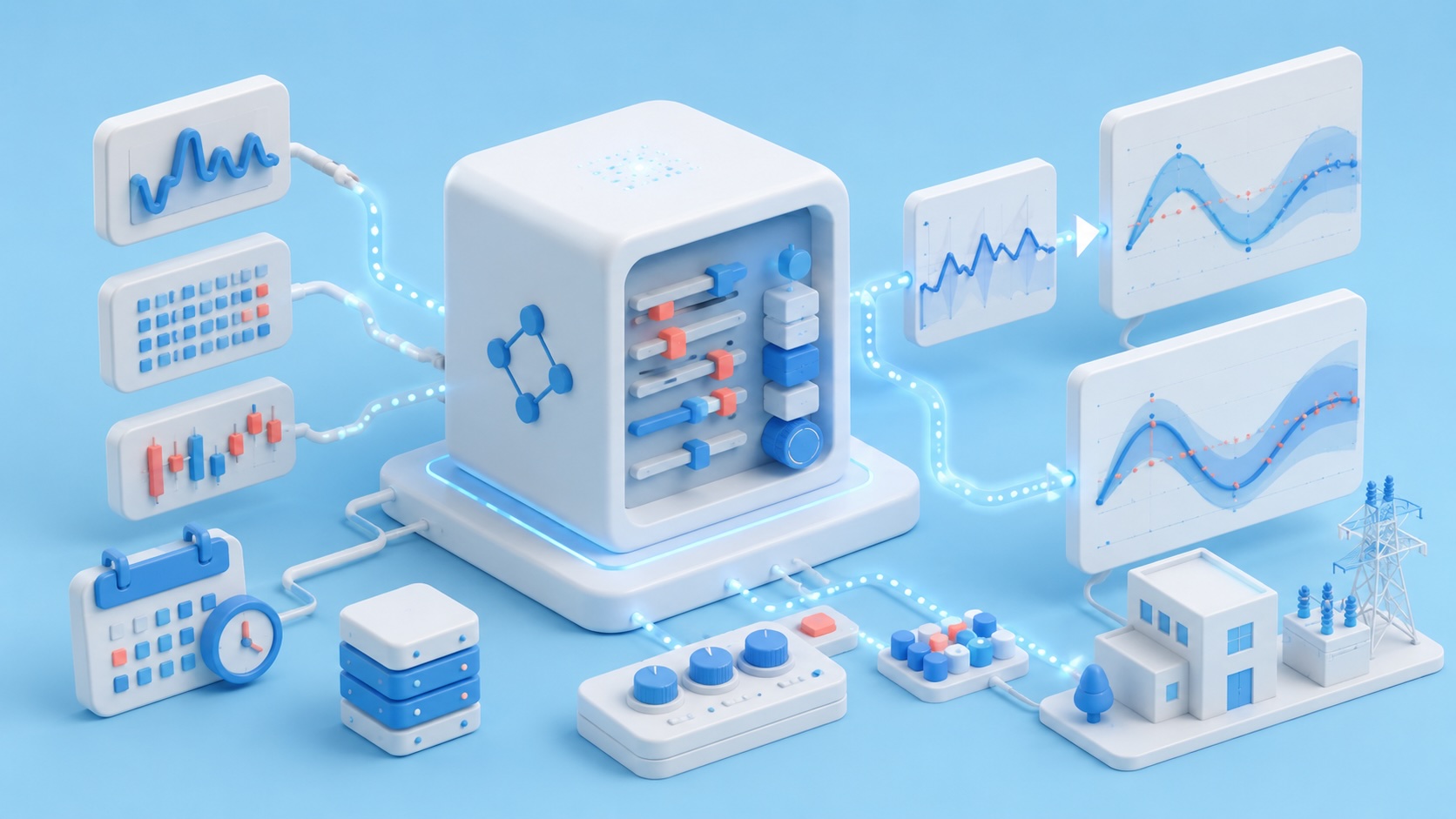
This is the most granular level: taking Chronos-2 and tuning it specifically for a single building’s electricity demand. This approach is ideal when an individual asset has highly idiosyncratic patterns that significantly deviate from the norm. It’s like teaching a general practitioner to become a specialist in one rare condition.
Portfolio Fine-Tuning: The Power of Pooled History
Often, individual assets within a portfolio (like a fleet of commercial buildings) share common operational characteristics or environmental influences. Portfolio fine-tuning allows you to pool historical data across multiple assets to train a shared adapter. This method use collective wisdom, leading to more strong predictions for the group, especially when individual asset data is sparse but the aggregate provides a stronger signal.
Covariate-Informed Fine-Tuning: Predicting the Unpredictable
Forecasting is always better when you can incorporate known future information. Covariate-informed fine-tuning allows you to feed the model signals that are known to influence your target variable in the future. For electricity demand, this could be upcoming weather forecasts (temperature, humidity) or scheduled events (holidays, planned maintenance). This adds a layer of predictive power that pure historical analysis can’t achieve.
The Best of Both Worlds: Portfolio + Covariates
This is where things get truly powerful. Combining portfolio-level adaptation with covariate information creates a sophisticated forecasting engine. It captures both the collective patterns of your asset fleet and the influence of external, future-known factors. This synergy can lead to a significant leap in prediction accuracy.
Held-Out Transfer: Proving Generalizability
This scenario is a critical test of the model’s true adaptability. After fine-tuning on a specific dataset (or portfolio), you then deploy it on assets that were never seen during the training or fine-tuning process. Success here demonstrates that the fine-tuning has imbued Chronos-2 with generalized adaptive capabilities, not just memorized patterns of the training set.
A Historical Parallel: From General Theory to Applied Science
This push towards fine-tuning mirrors a historical trajectory in scientific and engineering fields. Initially, we develop broad theoretical frameworks (the pre-trained model). Then, to solve specific, real-world problems, we need to adapt those theories to particular conditions and datasets. Think of how Newtonian physics provides a universal framework, but engineers must apply and refine those principles for specific bridge designs, aircraft aerodynamics, or electrical grid management. Chronos-2’s fine-tuning capabilities are the applied science equivalent for time series data.
The ability to adapt these powerful foundation models efficiently, without a full retraining budget, democratizes advanced AI. It means that businesses that previously might have been priced out or lacked the technical expertise to build custom models from scratch can now use state-of-the-art forecasting. This isn’t just about better predictions; it’s about making AI a more integral and impactful part of operational strategy across the board.
FAQ
Will fine-tuning Chronos-2 replace my job?
Fine-tuning Chronos-2 is designed to augment, not replace, human expertise. It automates complex forecasting tasks, freeing up analysts to focus on higher-level strategy, interpretation of results, and managing the exceptions that even fine-tuned models might miss. Your role might evolve to oversee and guide these AI systems.
How much data is needed for effective fine-tuning?
The amount of data required varies depending on the complexity of the patterns and the specific fine-tuning strategy. LoRA’s efficiency means that meaningful adaptation can often be achieved with significantly less data than full model retraining, potentially ranging from weeks to months of relevant historical data, depending on the data’s noisiness and seasonality.
Is Chronos-2’s fine-tuning suitable for real-time forecasting?
Yes, the efficiency of LoRA makes it well-suited for scenarios requiring near real-time adaptation. Once a model is fine-tuned, inference is typically very fast. For dynamic environments where patterns shift rapidly, periodic re-fine-tuning or adaptive learning techniques can be employed to maintain accuracy.