Could a large language model, not a Nobel laureate, soon be the engine behind humanity’s next great scientific leap?
That’s the provocative question simmering beneath the surface of recent developments at OpenAI, particularly concerning GPT-5’s capabilities beyond the mundane tasks of email drafting and basic coding. While much of the public discourse, and indeed initial tech press, focused on whether GPT-5 could write a better reply to Uncle Barry’s Facebook rant, a far more significant shift was occurring in the rarefied air of theoretical physics. Alex Lupsasca, a physicist celebrated for his work on black holes and a recipient of the prestigious New Horizons in Fundamental Physics Breakthrough Prize, has been tracking this evolution, and his findings suggest we’re not just seeing incremental progress; we’re witnessing a paradigm shift.
The ‘Oscar for Physics’ and an AI Revelation
Lupsasca, whose early career accolades include the “Oscar for physics,” first encountered AI’s potential for his field through personal experience. He recalls submitting a complex calculation to a model that would have consumed days of his time, only to receive a verified result in a mere eleven minutes. This was a watershed moment, yet his physicist peers and the broader scientific community met GPT-5’s release with, as Lupsasca puts it, a “lukewarm or skeptical reception.” The prevailing sentiment? It’s not significantly better at writing emails.
This disconnect highlights a fundamental misunderstanding of where the true power of these advanced AI systems lies. For those pushing the boundaries, for the researchers wrestling with intractable problems, the limits haven’t just moved outwards; they’ve dissolved.
When GPT5 came out, it was able to reproduce one of my best papers (that took a very long time to come up with) in 30 minutes.
This wasn’t just a speed boost; it was a demonstration of qualitatively different capability. The AI wasn’t just faster; it was able to synthesize and reproduce complex, novel research outputs with astonishing speed. For Lupsasca, this was not an evolutionary step for LLMs, but a revolution for scientific discovery.
The ‘Move 37’ Moment for AI x Physics
What Lupsasca terms the ‘Move 37 Moment’ — a nod to scientific breakthroughs often occurring after extensive iteration and unexpected turns — occurred when GPT-5, initially refusing a complex problem from a recent paper, was coaxed into action. After a simple “textbook warmup” prompt, the model not only solved the original problem but did so by reproducing Lupsasca’s own paper within minutes. This was after the model’s training cutoff date, implying genuine, albeit guided, novel problem-solving.
This immediate, high-impact success spurred Lupsasca’s move to OpenAI, aiming to accelerate AI’s role in theoretical physics. He began challenging the AI with his colleagues’ toughest problems.
AI Solved It Before the Plane Landed
One particularly striking example involved a decades-old conundrum in theoretical physics concerning “single-minus gluon tree amplitudes.” A formula for these quantities, which appeared non-zero in certain cases previously believed to always vanish, had been intractable for over a year. Lupsasca’s former PhD advisor, Prof. Andrew Storminger, was set to visit OpenAI to tackle it.
During the week of Prof. Storminger’s planned visit, ChatGPT, working with Lupsasca’s team, fully solved the problem. In Lupsasca’s words, it was solved “before Prof. Storminger’s plane even landed.” The AI didn’t just find a solution; it identified a critical limiting case—the “half-collinear regime”—that provided an intuitive explanation, collapsing the complex results into a simple formula. Astonishingly, it then proved this formula using a technique previously unknown to the researchers.
The Dawn of ‘Vibe Physics’
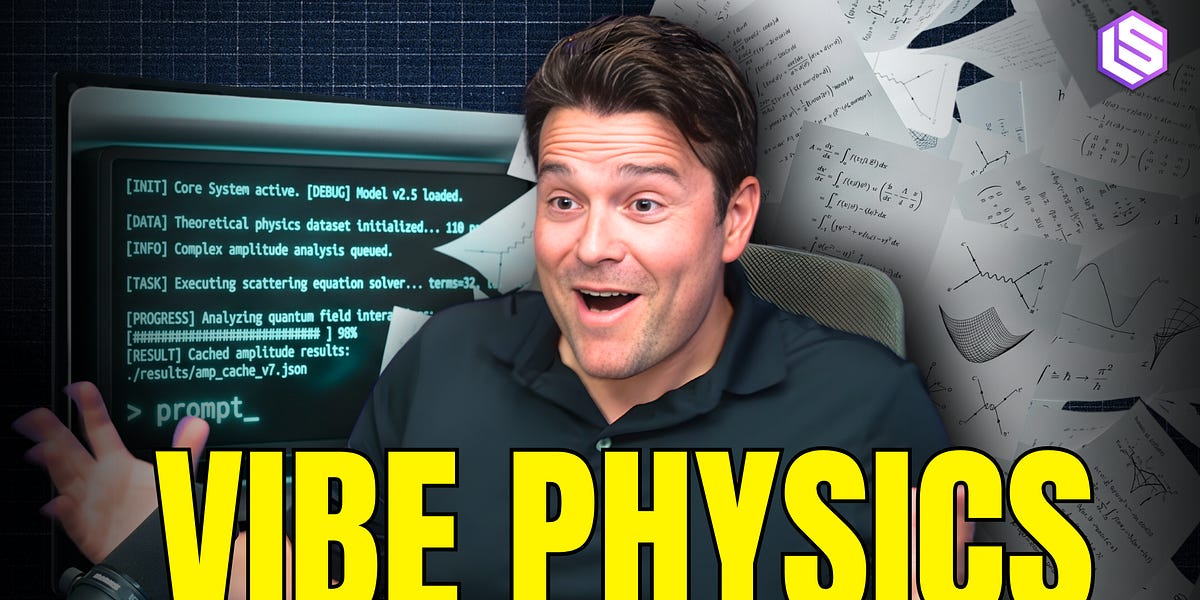
With concrete successes under its belt, the team then posed the ultimate challenge: could ChatGPT generate new physics from scratch? They directed it to research gravitons, the hypothetical particles mediating gravity. The result? 110 pages of novel physics, new calculations, and innovative techniques generated over a single day. This output, described as “vibe physics,” represents an unprecedented acceleration in scientific ideation, a proof to the AI’s ability to navigate complex theoretical landscapes with emergent creativity.
The interaction followed a now-familiar pattern for AI agents:
GPT: Here's your <long, detailed, awesome result>.
Would you like me to do <another related task or refinement>?
This isn’t just about faster computation; it’s about democratizing high-level scientific research. The barrier to entry for complex theoretical physics may be plummeting, allowing a broader range of minds, amplified by AI, to explore the universe’s deepest mysteries. The implications for discovery, for our understanding of everything from black holes to the origins of the cosmos, are staggering. The question is no longer if AI can do science, but how we will collectively integrate this new, powerful collaborator into the human quest for knowledge.
Why Does This Matter for Researchers?
For researchers across disciplines, Lupsasca’s work with GPT-5 is a stark indicator of the future. The ability of advanced LLMs to not just process information but to synthesize, hypothesize, and generate novel insights at speeds and scales previously unimaginable, fundamentally alters the scientific workflow. Expect more “AI-solved-before-arrival” scenarios. The emphasis will likely shift from laborious computation and brute-force exploration to sophisticated problem formulation, critical evaluation of AI-generated hypotheses, and the guiding of AI’s emergent capabilities.
This isn’t about AI replacing scientists; it’s about AI becoming an indispensable, perhaps dominant, tool in their arsenal. Those who fail to adapt, those who remain skeptical of its transformative potential beyond basic utility, risk being left behind on the jagged frontier of discovery.
🧬 Related Insights
- Read more: NYT’s Bombshell: Adam Back as Bitcoin’s Hidden Inventor — Or Just Cypherpunk Coincidence?
- Read more: AI Agents Flag 25 Invalid Moves in Public Goods Game—Stress-Testing Incentive Designs Like Never Before
Frequently Asked Questions
What is ‘vibe physics’? ‘Vibe physics’ refers to the emergent and sometimes intuitive generation of novel scientific concepts and calculations by advanced AI models, like ChatGPT, pushing the boundaries of theoretical physics beyond traditional, human-driven methods. It highlights the AI’s ability to produce substantial, advanced research output with relative speed and an often uncanny understanding of underlying principles.
Can AI like GPT-5 actually do original scientific research? Based on Alex Lupsasca’s experiences at OpenAI, yes. GPT-5 has demonstrated the ability to reproduce complex papers, solve intractable problems previously unfocused for humans, and even generate entirely new avenues of research, as seen in the ‘vibe physics’ experiment with gravitons. While the AI still requires human guidance in problem definition and evaluation, its capacity for novel output is becoming increasingly apparent.
Will AI replace theoretical physicists? It’s more likely that AI will become an indispensable tool for theoretical physicists, augmenting their capabilities and accelerating the pace of discovery rather than outright replacing them. The role of the physicist may evolve towards problem formulation, critical analysis of AI outputs, and the strategic direction of AI-driven research, allowing for exploration of more complex questions at an unprecedented speed. The need for human intuition, creativity, and critical judgment in validating and interpreting scientific findings will likely remain paramount.