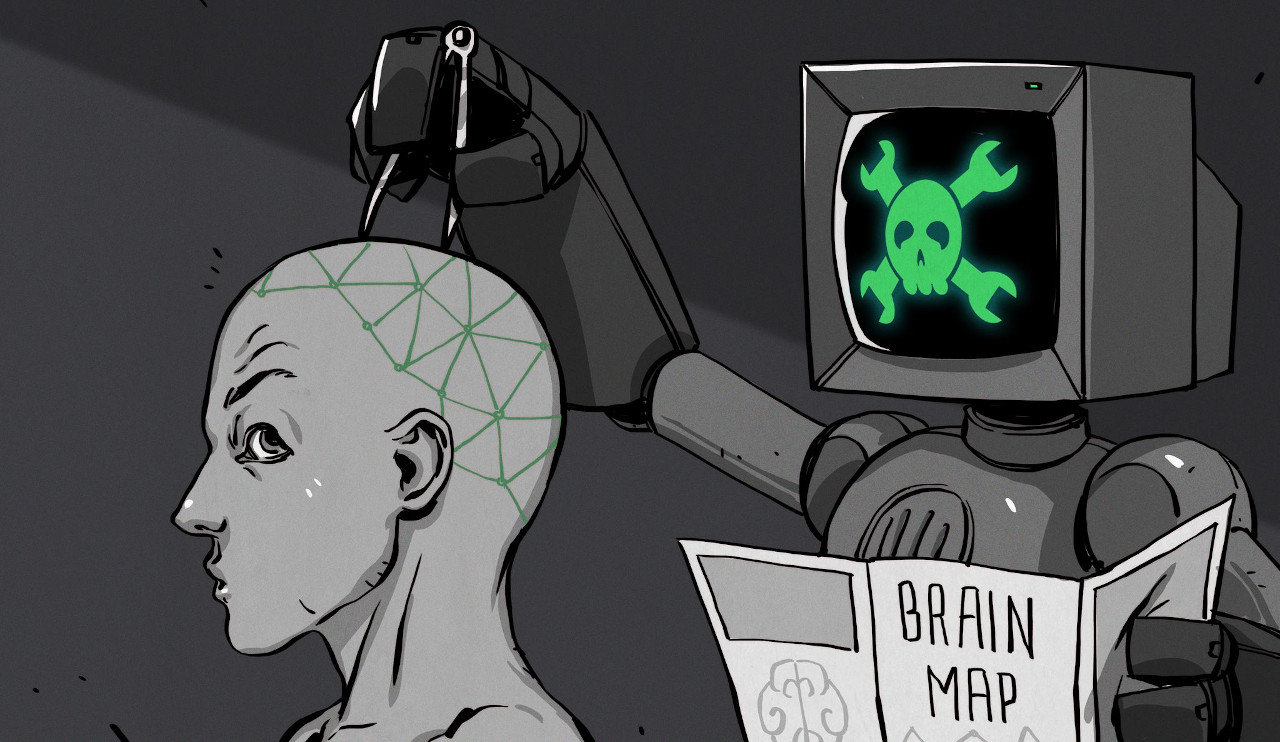
The hum of servers processing vast datasets. A cascade of glowing text on screens, spitting out prose that’s eerily human-like. Then, the inevitable marketing salvo: ‘It’s AI.’ For years now, ‘AI’ has been the ultimate buzzword, a shiny label slapped onto everything from smart thermostats to predictive text. But peel back the glossy veneer, and the picture gets a lot messier. We’re told this ‘artificial intelligence’ is curing diseases, mastering chess, and writing symphonies, all while making our lives exponentially better. Yet, as De La Soul’s Plug One (Dave) famously quipped in ‘Me Myself and I,’ the foundational track that birthed a thousand sampling techniques: “You keep using that word. I do not think it means what you think it means.”
And that’s precisely the problem. The relentless application of ‘AI’ to every conceivable technological advancement — from ‘smart’ appliances to sophisticated algorithms— risks conflating genuine cognitive leaps with mere computational prowess. It’s an echo of the early 20th century’s fascination with ‘electronic brains,’ a term that promised a future of super-intelligence but often delivered little more than complex calculators. Today, instead of vacuum tubes, we have silicon chips, and instead of world-altering breakthroughs, we often find ourselves doom-scrolling or engaging in digital skirmishes, the modern primate defending its online turf. The current AI narrative wildly oversells what’s been achieved, presupposing we’ve cracked the code of sentience and created intelligence capable of rivaling humans, or even our avian dinosaur cousins.
The real kicker? There’s a veritable mountain of fascinating algorithms and complex constructs that automate tasks with impressive flair. To simply dismiss all this under the broad umbrella of ‘AI’ feels like a disservice, a regression from the lessons learned during the AI panics of the 1980s. What, exactly, is getting smoothed over by this ‘everything is AI’ marketing gloss?
Cognition Versus Intelligence: A Fuzzy Line
Intelligence itself is a slippery concept. We often talk about fluid intelligence (Gf) – the capacity to reason and solve novel problems – as a cornerstone of what makes us, well, intelligent. Add to that memory, the ability to acquire and recall knowledge, and learned skills, and you have the bedrock of general intelligence. You could, and many do, argue that intelligence is fundamentally about acquiring data, processing it, and applying reasoning to derive new conclusions.
However, the CHC (Cattell-Horn-Carroll) model of intelligence, a widely accepted framework, expands this to include sensory and motor capabilities, and efficiency metrics. These, of course, are inherently species-centric. It’s hard to divorce cognitive processes from sensory input and output mechanisms – the ‘in’ and ‘out’ that allow any form of intelligence to interact with its environment. Without senses to perceive and actuators to act, intelligence, no matter how profound, remains inert.
And herein lies the academic quagmire: the lack of firm consensus on where to draw the line between ‘intelligence’ and ‘cognition’ only muddies the waters further. This ambiguity allows for systems that merely mimic fragments of human cognitive processes, like machine vision, to be branded as ‘AI,’ even when they lack the underlying reasoning and understanding that accompanies those processes in biological organisms.
What we can conclude, then, is that what we currently label as ‘smart’ or ‘AI’ are often systems designed to replicate specific, isolated fragments of human cognitive processes.
Machine Vision: The Ultimate Task-Specific Proving Ground
Machine vision (MV) stands out as a prime example of this technological dichotomy. Its greatest strength lies in its ability to offload cognitively demanding tasks to computer systems that don’t suffer from fatigue or distraction. Think quality assurance on a high-speed production line. Instead of a human eye meticulously scanning hundreds of items per minute for microscopic defects, an MV system can perform this task with unwavering consistency and far greater efficiency.
MV encompasses a vast array of implementations, each meticulously tailored to a specific objective. These systems use diverse sensors – visible light cameras, near-infrared, and more – to detect flaws, spoilage, or other anomalies in products ranging from printed circuit boards to packaged foods. The data collected is then fed into a programmed system capable of identifying deviations from the norm.
At a circuit board manufacturing facility, for instance, suspect PCBs are flagged. A human operator might then intervene, either confirming the defect for removal or marking it as a false positive, allowing the board to continue. The primary benefit here is a significant reduction in the cognitive load placed on human workers, who, let’s be honest, aren’t exactly renowned for their sustained concentration on repetitive, detail-oriented tasks.
The systems themselves, however, are not exhibiting general intelligence. They are executing highly specialized routines. A system trained to detect a specific type of solder bridging will fail spectacularly if asked to identify a cosmetic scratch on a product housing. It’s an incredibly powerful form of pattern recognition, meticulously engineered for a narrow purpose.
The main advantage here is that it reduces the cognitive load on the humans, who are notoriously terrible at lon[g periods of sustained attention.]
This quote, while referencing human limitations, inadvertently highlights the limitations of the machine. The MV system isn’t better at discerning complex situations; it’s simply more consistent at a specific, pre-defined task. It’s a finely tuned instrument, not a polymath.
The Specter of the 1980s AI Winter
This reliance on narrow task automation, dressed up as general intelligence, carries a distinct whiff of the past. During the 1980s AI boom, researchers were enamored with expert systems – programs designed to mimic the decision-making ability of a human expert in a specific field. These systems were impressive, capable of diagnosing medical conditions or configuring complex computer systems. But they were brittle. Ask an expert system to deviate even slightly from its programmed domain, and it would flounder.
When the limitations became apparent, and the promised broad intelligence failed to materialize, funding dried up, and the field entered its first ‘AI winter.’ Today’s generative AI models, while vastly more capable and sophisticated, share this underlying characteristic: they excel within their training parameters but lack genuine, flexible reasoning.
Consider large language models (LLMs). They can generate incredibly coherent text, translate languages, and even write code. But ask an LLM to perform a simple logic puzzle that requires common-sense reasoning outside its typical training data distribution, and it can often falter. It’s pattern matching on a grand scale, not true understanding.
This isn’t to diminish the technological marvels. Machine vision, natural language processing, and advanced robotics are transforming industries. But the overarching narrative needs a recalibration. We need to distinguish between systems that automate cognitive tasks and those that exhibit genuine intelligence – the ability to learn, adapt, and reason across novel domains.
Why Does This Matter for Developers?
The distinction is critical for developers. If you’re building systems that rely on machine vision, you’re working with sophisticated pattern recognition tools, not nascent artificial minds. Understanding the architectural limitations and the specific training data requirements is paramount. The success of your project hinges on precisely defining the problem space and selecting the appropriate algorithmic tools, rather than expecting a silver-bullet ‘AI’ solution.
For those working with LLMs, the challenge lies in prompt engineering, fine-tuning, and understanding the inherent biases and probabilistic nature of these models. Building applications that use LLMs effectively means designing workflows that account for their strengths (text generation, summarization) and weaknesses (factual inaccuracies, reasoning gaps).
The ongoing hype cycle around ‘AI’ also risks setting unrealistic expectations for stakeholders and end-users. When a company touts its ‘AI-powered’ solution, it’s incumbent upon the development team to understand and articulate what that actually means in practical terms. Is it a complex statistical model, a rule-based system, or a neural network trained on massive datasets? Clarity here prevents misapplication and disillusionment.
The field is advancing at an astonishing pace, and truly remarkable things are being built. But to navigate this landscape effectively, we need to move beyond the buzzword. We need to understand the architecture, the algorithms, and the fundamental differences between sophisticated automation and genuine artificial intelligence. The future isn’t just about what machines can do, but about what we truly understand them to be doing.
🧬 Related Insights
- Read more: One Dev’s Rush: Wiring On-Device AI into a Roguelike RPG in Days
- Read more: One Spoonful from 330 Million: How Sampling Methods Nail Predictions Without the Full Picture
Frequently Asked Questions
What does ‘AI’ actually refer to in most products today? Most products labeled ‘AI’ today utilize sophisticated algorithms for specific tasks like pattern recognition (machine vision), natural language processing (chatbots), or predictive analysis. They are essentially advanced forms of automation designed to mimic certain human cognitive functions within narrow domains.
Will current AI systems replace human jobs? Current ‘AI’ systems are primarily designed to automate repetitive or data-intensive tasks. While this will undoubtedly lead to shifts in the job market, particularly in roles involving routine cognitive work, it’s more likely to augment human capabilities and create new roles focused on AI development, management, and oversight. Genuine replacement of complex human roles requiring broad reasoning and creativity is still a distant prospect.