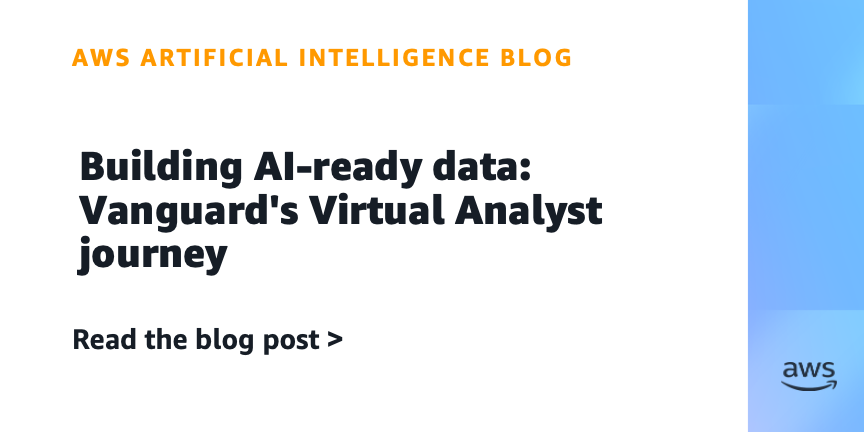
Here’s the thing about Silicon Valley these days: every other press release screams about AI. It’s usually a thinly veiled rehash of using some fancy new language model to do what a search bar has done for decades, just with more jargon and a heftier price tag. So when I saw Vanguard – yeah, the staid investment giant, not some trendy startup – talking about their ‘Virtual Analyst journey’ and ‘AI-ready data,’ I raised an eyebrow. Twenty years covering this circus teaches you to look past the sparkle.
And that’s exactly what Vanguard’s analysts were doing. Imagine needing to ask about complex financial datasets. Your average analyst? They weren’t firing up a chatbot. Nope. They were wrestling with SQL, writing complex queries that took days to get an answer. Days. In finance, that’s an eternity. This isn’t a unique problem, mind you. Companies everywhere are staring at mountains of data and realizing their old tools just aren’t cutting it when they want quick, conversational insights.
So, they decided to build a ‘Virtual Analyst.’ Sounds fancy, right? Like something out of a sci-fi flick. But the real story, the one buried under the buzzwords about foundation models and AWS services, is far more terrestrial. It’s the painstaking, unsexy work of getting enterprise data ready for AI. Forget the flashy AI itself for a moment; the actual challenge, as Vanguard discovered, was the data architecture.
Is This Just More Corporate Hype?
Let’s be clear: the shiny object here is the conversational AI. But Vanguard’s own team stumbled onto a truth that many companies conveniently gloss over: even the smartest Large Language Models are only as good as the data they’re fed. You can’t just point a fancy AI at your messy, siloed, decades-old database and expect brilliant, accurate answers. It’s like expecting a Michelin-star chef to whip up a gourmet meal using only ingredients from a dumpster fire. No, you need a foundation. And that, for Vanguard, meant building ‘AI-ready data.’
The whole setup feels less like a revolution and more like a necessary evolution, albeit one dressed up in AI parlance. The real win, the one that actually makes money (and believe me, that’s always the question), is whether this makes their analysts more efficient and their decision-making faster. The article hints at ‘measurable business outcomes,’ but the nitty-gritty details are always a bit vague, aren’t they?
When Data Silos Attack
The biggest hurdle wasn’t picking the right AWS service or the most cutting-edge foundation model. No, it was something far more pedestrian: collaboration. Vanguard pulled together data engineers, business analysts, compliance officers, security folks, and the actual business users. Why? Because each group holds a crucial piece of the puzzle. The engineers know the pipes, the analysts know what the numbers mean in real-world financial terms, and compliance ensures you don’t end up on the front page for the wrong reasons. This cross-functional ballet is where the magic—or at least, the functionality—happens.
Without clear ownership models, semantic definitions, and quality standards that all teams could understand and contribute to, the AI solution would not have a good foundation.
That quote, right there. That’s the core of it. It’s not about the AI; it’s about governance, clarity, and shared understanding of what the data is. This project, apparently, became a catalyst for better processes, which is great, but let’s not pretend this is entirely novel. It’s just taking the age-old problem of data management and slapping an AI label on it.
The Tech Stack: AWS, Obviously
Naturally, they leaned on AWS. Because who doesn’t these days? Amazon Bedrock for the foundation models (the brains, allegedly), Bedrock Guardrails to keep sensitive financial data from wandering off, DynamoDB for chat persistence (because who wants to lose their AI conversation?), S3 for storage, SageMaker for fiddling around, Redshift for the data warehouse, and Glue for cataloging. It’s a standard enterprise toolkit for anyone trying to wrangle data at scale. The impressive part isn’t the choice of services, but the application of them to make the data speak a language the AI can understand.
They’re touting eight guiding principles for this ‘AI-ready data.’ And honestly, they sound like common sense data governance dressed up in a new outfit. Establish clear data products. Ensure data quality. Manage metadata. Make data discoverable. Provide semantic context. Govern access. Ensure security and compliance. Optimize for performance. These are the bedrock of any good data strategy, AI or not. The novelty is how they’re framing it as a prerequisite for AI, which, to be fair, it absolutely is.
But who’s really making money here? AWS, for one, selling its cloud services. And maybe Vanguard, if this ‘Virtual Analyst’ actually churns out better investment strategies or reduces operational costs. The consultants who helped them set it all up? Definitely. For the average financial analyst? Hopefully, their job just got a little less tedious and a lot more insightful. But the AI itself? It’s a tool, a very expensive one, that requires a massive investment in its plumbing.
🧬 Related Insights
- Read more: Swagger vs Postman: One Dev’s Hack Exposes Your API Testing Black Holes
- Read more: Google’s Lyria 3 Lands in Gemini: AI Jingles or Music’s Demise?
Frequently Asked Questions
What does Vanguard’s Virtual Analyst actually do?
Vanguard’s Virtual Analyst is an AI-powered tool designed to give financial analysts faster, more direct access to complex financial data. Instead of writing complex SQL queries that take days, analysts can ask questions in natural language and receive immediate responses, improving efficiency and decision-making speed.
Will this AI replace financial analysts?
The article doesn’t suggest a direct replacement. Instead, it frames the Virtual Analyst as a tool to augment analysts’ capabilities, freeing them from tedious data retrieval tasks so they can focus on higher-value analysis and decision-making. The emphasis is on improved efficiency rather than headcount reduction.
What is ‘AI-ready data’?
‘AI-ready data’ refers to data that has been structured, cataloged, and contextualized in a way that makes it easily accessible and understandable for artificial intelligence systems. This involves establishing clear data products, ensuring high data quality, managing metadata, and providing semantic context, essentially preparing the data foundation for AI tools to function reliably and accurately.