Look, everyone was expecting the next big leap in LLM performance benchmarks with Anthropic’s Claude Opus 4.8. We’ve all become accustomed to the yearly – sometimes quarterly – parade of models setting new records, pushing the needle just a millimeter further on complex reasoning tasks. It’s a familiar dance.
But this time, the vibe feels different. It’s not just about a slightly better chatbot or a more accurate code generator. We’re witnessing something far more profound: the emergence of AI as a fundamental platform shift, akin to the internet or the mobile revolution. This isn’t just an incremental upgrade; it’s a foundational reshaping of how we build, deploy, and interact with technology.
The Platform is the Product
When Anthropic dropped Opus 4.8, the initial reactions were a mix of praise and qualified enthusiasm. Independent benchmarks showed “incremental but not dominant” gains. Some tests highlighted it as more efficient but barely nudging the needle compared to its predecessor. Others noted minor improvements in document parsing but regressions in content faithfulness.
Anthropic also shipped useful platform-level changes: @ClaudeDevs announced mid-conversation system instructions without breaking prompt cache, plus authoritative mid-conversation system-role updates, which matters for long-running agent sessions and cost control.
This quote, buried slightly in the technical recaps, is the real headline. The ability to dynamically adjust system instructions mid-conversation, without nuking the prompt cache, is huge. It signals a move away from static prompts to a more fluid, interactive AI experience – the hallmark of a true platform.
Think of it like this: before the iPhone, we had mobile phones. They made calls, sent texts. Powerful for their time, but limited. Then came iOS. Suddenly, third-party developers could build on top of this new platform. Apps, services, whole ecosystems bloomed. Opus 4.8’s mid-conversation instruction updates are a tiny, but critical, step towards that kind of architectural freedom for AI applications.
Agentic AI: The New Operating System?
Beyond Opus 4.8 itself, the chatter around agentic AI and the infrastructure supporting it is where this platform shift truly ignites. We’re seeing deep dives into subtle RL (Reinforcement Learning) failure modes – like the silent bugs in tool-using, multi-turn RL training loops where tokenization shifts can corrupt gradients. This isn’t just abstract research; it’s the plumbing of the next generation of AI.
This focus on “Token-In, Token-Out” rules and the foundational role of “renderers” between messages and tokens tells us developers are wrestling with the low-level mechanics of building strong AI systems. It’s the equivalent of early internet engineers figuring out TCP/IP protocols. Messy, complex, but essential for what comes next.
And then there’s the emerging discipline of harness design. Work on Effective Feedback Compute (EFC) suggests that raw token or tool counts are poor predictors of agent success. Instead, harness quality – how well the AI agent is guided and structured – matters immensely. This is akin to operating systems and their ability to efficiently manage resources for applications.
Productized tuning efforts, like those from LangChain with Deep Agents, are making strong performance achievable with open-weight models at a fraction of the cost of frontier APIs. The message is clear: different models need different prompts and tools. This is the artisanal craftsmanship of building on the AI platform.
Open Models: The Open Source Foundation
The momentum behind local-first and open-weight models continues to be a crucial accelerant. With roughly one in three AI teams now running an open-weights model, and these models lagging frontier proprietary versions by only about four months, the democratization of AI is in full swing. This open-source toolchain is laying the groundwork for an entire universe of AI applications, accessible to more people than ever before.
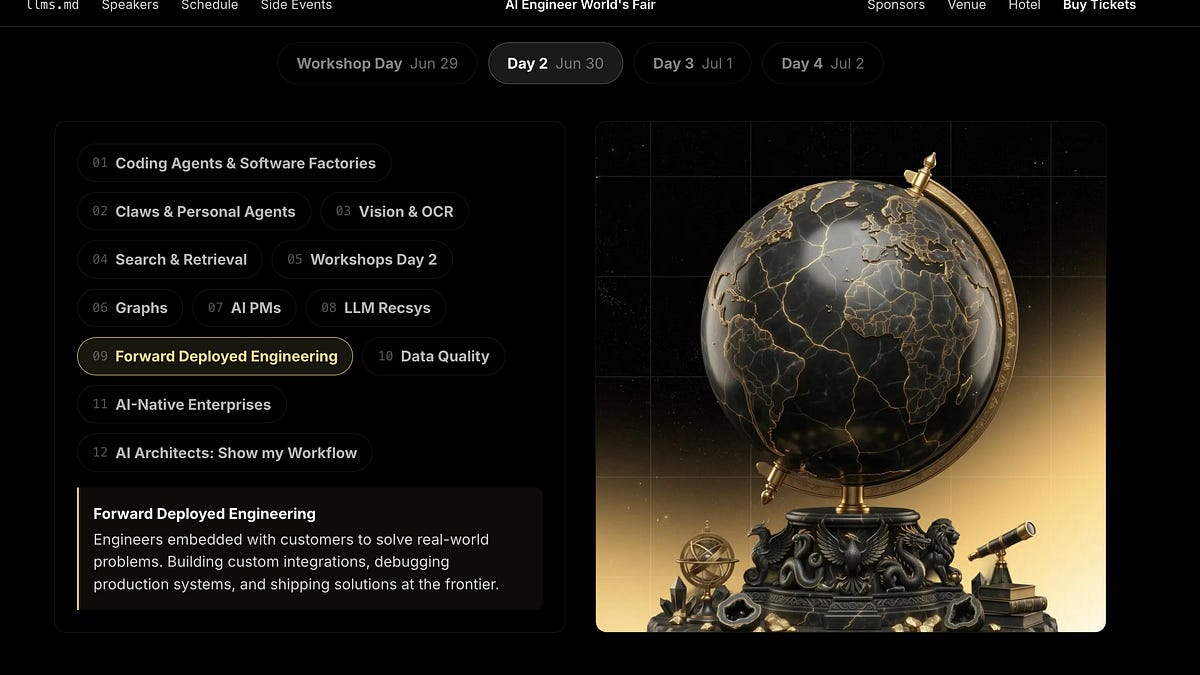
This is where the AIE WF focuses you mentioned, like their new Forward Deployed Engineer track and Founders program, become incredibly significant. They’re not just creating a space for developers; they’re actively cultivating the ecosystem builders, the innovators who will push the boundaries of this new platform. It’s less about who has the biggest model and more about who can build the most compelling applications on AI.
My Take: The Rise of the AI Artisan
What’s truly exciting – and frankly, a little mind-boggling – is that the debate is shifting. It’s moving from “single vs. multi-agent” to where the real value of abstraction lies. Some argue current multi-agent systems are mere speedups, not capability unlocks. Others foresee swarm-style training leading to emergent planning and superintelligence-like behaviors. My unique insight here is that this isn’t an either/or situation. It’s about the emergence of the AI Artisan. These aren’t just coders or data scientists anymore; they’re creators who understand the nuances of AI models, prompt engineering, agentic workflows, and harness design. They’re the new craftspeople of the digital age, building bespoke solutions on a rapidly evolving AI platform.
🧬 Related Insights
- Read more:
- Read more: Advenica’s USB Kiosk Promises Malware-Free Transfers—But Is It Just Air-Gapping in a Box?
Frequently Asked Questions
What is Claude Opus 4.8? Claude Opus 4.8 is the latest iteration of Anthropic’s large language model, featuring incremental performance improvements and notable platform-level enhancements like mid-conversation system instruction adjustments.
Will AI replace my job? While AI will undoubtedly automate certain tasks and transform many roles, it’s also creating new opportunities, particularly for those who can use AI tools and build AI-powered applications. The focus is shifting towards skills in AI development, integration, and creative problem-solving.
What is the significance of agentic AI? Agentic AI refers to systems capable of acting autonomously to achieve goals. The ongoing work in this area, including research into RL training and harness design, is crucial for developing more sophisticated and capable AI applications that can operate as independent agents.